
Can dogs eat mustard?
Updated 8 August 2026
No, mustard is unsafe for dogs and worth keeping off any plate they can reach. Vets Now names both mustard and ketchup among the barbecue condiments that harm dogs, mainly through their salt, sugar and, in some brands, artificial sweeteners. English mustard and mustard powder are the strongest versions, and flavoured jars sometimes add garlic, onion or honey too.
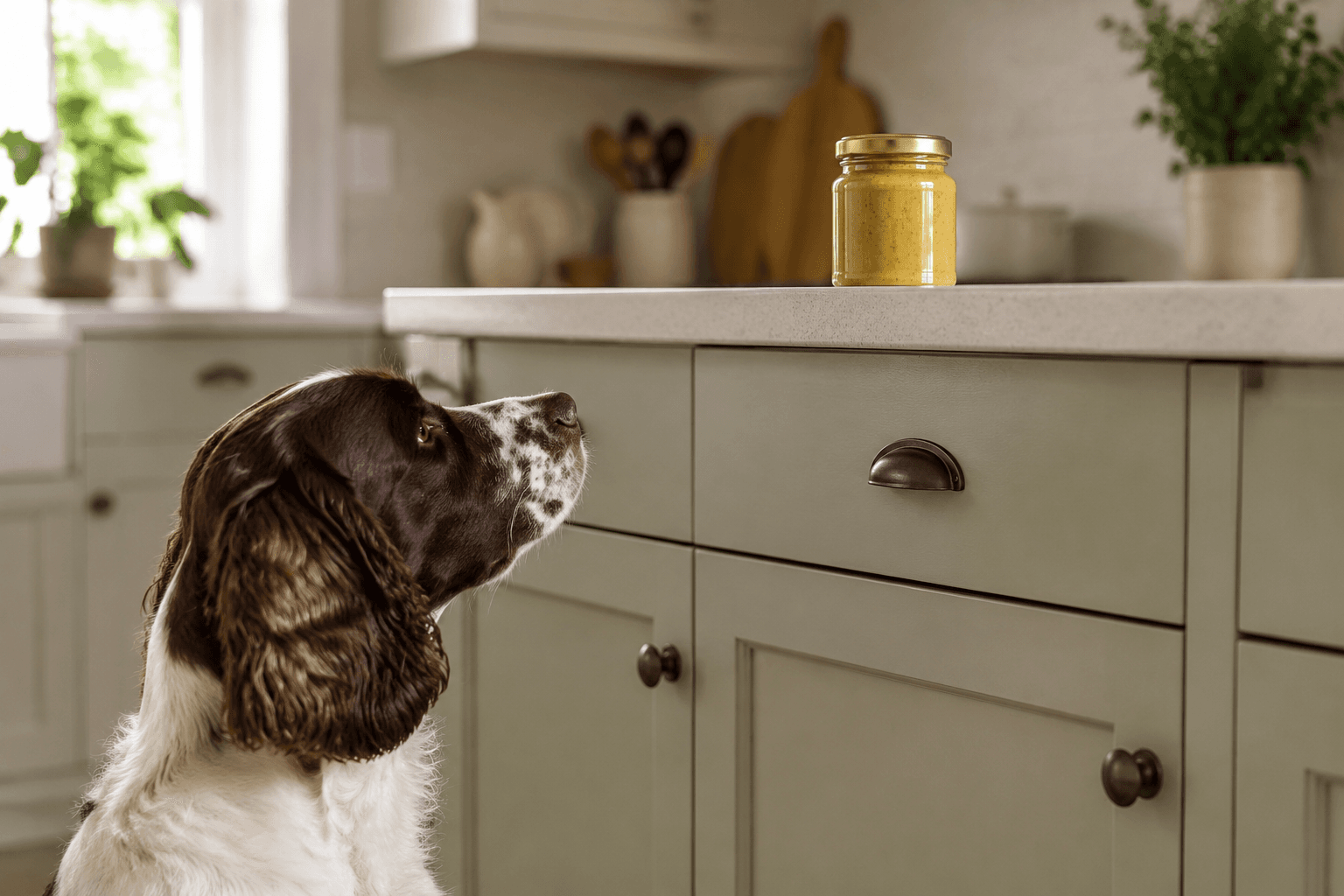
If your dog has eaten mustard
If your dog has licked a small smear of ordinary mustard off a plate, offer fresh water and keep an eye on them rather than panicking. Call your vet if your dog has eaten a spoonful or more, a squeezed tube, a tin of mustard powder, or anything containing garlic, onion or a sweetener, and tell them roughly how much and what type was eaten. Do not try to make your dog vomit with mustard or any other home remedy, since the MSD Veterinary Manual specifically lists mustard among the substances that should never be used this way.
- The detail
- Is English mustard more dangerous than American mustard?
- My dog ate a jar of mustard or a tin of mustard powder, what now
- Are honey mustard and garlic mustard worse than plain mustard?
- Can dogs eat mustard greens, the leafy vegetable?
- What to do if my dog steals a hot dog or burger with mustard on it
- Is mustard in a cheese sauce or salad dressing riskier than the jar itself?
- Better things to share
- Common questions
The detail
Mustard on a plate might look harmless, but vets treat it as a condiment to keep away from dogs rather than a garnish to share. Vets Now's guide to barbecue safety for dogs names mustard alongside ketchup as a squeezy-bottle risk, pointing to the salt, sugar and, in some brands, artificial sweeteners that go into a typical jar. None of those ingredients do a dog any good, and some can do real harm in the wrong amount.
The MSD Veterinary Manual's guidance for vets on treating poisoning cases lists mustard among the substances owners are specifically told never to use at home, grouped alongside dish soap, hot sauce and raw eggs as ineffective and inappropriate ways to try to make a dog vomit. That entry is really about outdated first-aid myths, but it says something useful about mustard itself: this is not a food vets consider gentle on a dog's stomach.
Not all mustards are equal. A mild American-style yellow mustard is diluted with vinegar, water and turmeric, while English mustard and mustard powder are far more concentrated, and wholegrain and Dijon sit somewhere in between with whole or crushed seeds adding texture. A dog that steals a squeeze of ketchup-style mustard off a hot dog is in a different situation from a dog that gets its nose into a tin of dry mustard powder or a jar of pickling seeds.
Flavoured mustards add their own problems on top. Honey mustard, garlic mustard and some artisan blends include ingredients that are separately risky for dogs, and PDSA's guidance on onion and garlic poisoning is clear that alliums damage a dog's red blood cells and can cause anaemia, with all parts of the plant toxic even when cooked or dried. Check the label of anything beyond a plain jar before assuming a small taste is fine.
Mustard turns up in more places in a British kitchen than the squeezy bottle. It is stirred into cheese sauces, ploughman's lunch pickles, salad dressings, rarebit and some marinades, often in a proper spoonful rather than a token squeeze. A dog helping itself to a bowl of cheese sauce or a jar of piccalilli is getting a bigger, more concentrated dose of mustard, salt and often onion or garlic than a lick off a hot dog, so it is worth thinking of mustard as an ingredient hiding in other dishes as well as the jar on the table.
Is English mustard more dangerous than American mustard?
Broadly, yes, because English mustard and mustard powder are made from ground mustard seed with very little dilution, so weight for weight they carry far more of the pungent oils that give mustard its heat. American-style yellow mustard is watered down with vinegar and turmeric, which makes an accidental lick less concentrated, even though the salt content is still there.
This is really a question of dose and concentration rather than one type being uniquely toxic and another being safe. A dog getting a proper mouthful of dry mustard powder or English mustard is a bigger concern than a dog managing to lick a smear of a milder sauce off a plate.
My dog ate a jar of mustard or a tin of mustard powder, what now
This is the scenario worth taking seriously, since a jar or tin holds far more salt and concentrated mustard oil than a single squeeze on a sandwich. Ring your vet and tell them roughly how much was eaten and which type, since powder and English mustard are more concentrated than a milder sauce.
Watch for vomiting, diarrhoea, excessive thirst or drooling over the next few hours. PDSA's guidance on poisons notes that salt poisoning becomes more likely when a large amount is eaten quickly without access to water, so make sure your dog can drink freely while you wait for advice.
Are honey mustard and garlic mustard worse than plain mustard?
Yes, treat any flavoured mustard as a bigger risk than a plain jar. Honey mustard and garlic mustard both add ingredients with their own separate problems, and PDSA's page on onion and garlic poisoning confirms alliums contain compounds that damage a dog's red blood cells and can cause anaemia, with vomiting, diarrhoea and lethargy appearing over the following days.
Some reduced-sugar condiments also lean on artificial sweeteners, and while not every brand uses xylitol, it is worth a quick label check before assuming any 'no added sugar' sauce is automatically safer for a dog.
Can dogs eat mustard greens, the leafy vegetable?
Mustard greens are a different food entirely from the condiment, a leafy brassica vegetable more closely related to cabbage and kale than to the seeds ground into a jar of mustard. They are generally treated as a much lower-risk food when cooked plainly and offered in small amounts, without the salt and concentrated oils that make the condiment worth avoiding.
If your dog has been offered mustard greens rather than mustard sauce, the more relevant concerns are the same as with any leafy vegetable, portion size and plain preparation, rather than the salt and irritant-oil risks covered on this page. Ask your vet if you are unsure.
What to do if my dog steals a hot dog or burger with mustard on it
A single bite of a shared hot dog with a smear of mustard is unlikely to be a genuine emergency for most healthy adult dogs, though it is still not something to encourage. The bigger concerns at a barbecue are usually the sausage or burger itself, since processed meat is often high in salt and fat too, and any onions in the mix.
Keep an eye out for an upset stomach over the next day, offer water, and call your vet if your dog seems unusually unwell, ate a large portion, or you know the food was heavy on onion, garlic or a strongly flavoured mustard.
Is mustard in a cheese sauce or salad dressing riskier than the jar itself?
Often, yes, because these dishes tend to use a proper spoonful of mustard rather than a light squeeze, and they frequently combine it with other risky ingredients. A classic rarebit or cheese sauce recipe adds mustard powder along with cheese, and a salad dressing might combine mustard with garlic and a good pinch of salt, stacking several separate risks into one dish.
If your dog gets into a bowl of leftover cheese sauce, a jar of piccalilli, or a jug of homemade dressing, treat it the same way as a larger mustard ingestion rather than assuming a diluted recipe makes it automatically safer. Call your vet if a meaningful amount was eaten.
Signs to watch for
- Vomiting or loose stools after a larger or concentrated amount
- Excessive thirst or urination from the salt content
- Drooling or pawing at the mouth after mustard powder or seeds
- Lethargy, tremors or disorientation in a serious salt-poisoning case
Common questions
Is a small lick of mustard dangerous for my dog?
Unlikely to be serious for most healthy adult dogs, but it is still not something to offer on purpose. Watch for an upset stomach over the following day and offer fresh water.
Which is worse for a dog, English mustard or American yellow mustard?
English mustard and mustard powder are more concentrated and less diluted than a milder American-style sauce, so a genuine mouthful of either is more concerning. Both still contain salt, which is the main everyday risk.
Can mustard kill a dog?
A small amount is very unlikely to be fatal, but PDSA notes that a large amount of salt eaten quickly, without access to water, can cause poisoning that is fatal. A jar, a tin of powder or a garlic-flavoured mustard eaten in quantity is the scenario to take seriously.
Is mustard powder more dangerous than mustard sauce?
Yes, weight for weight mustard powder is far more concentrated than a jarred sauce, since it has not been diluted with vinegar or water. A dog getting into a tin of dry mustard powder should see a vet.
Are honey mustard and garlic mustard worse than plain mustard?
Yes. PDSA's guidance confirms garlic and onion damage a dog's red blood cells and can cause anaemia, so any flavoured mustard containing them carries an extra risk plain mustard does not.
Can dogs eat mustard greens, the vegetable?
Mustard greens are a different food from mustard sauce, a leafy vegetable rather than a condiment, and are generally treated as a much lower-risk food in small, plain, cooked amounts. Ask your vet if you are unsure.
My dog ate a hot dog with mustard on it at a barbecue, should I worry?
A single bite is unlikely to be a genuine emergency for most dogs, though the sausage itself and any onion in the mix are worth thinking about too. Call your vet if your dog seems unwell or ate a large amount.