
Can dogs eat garlic?
Updated 7 August 2026
No. Garlic is toxic to dogs in every form, raw, cooked, dried or powdered, and PDSA names it alongside onions and leeks as part of the allium family that damages red blood cells. VCA Animal Hospitals identifies garlic as the most toxic member of that family, and says one teaspoon of garlic powder is equivalent to eight cloves of fresh garlic. If your dog has eaten a meaningful amount, ring your vet straight away rather than waiting for symptoms.
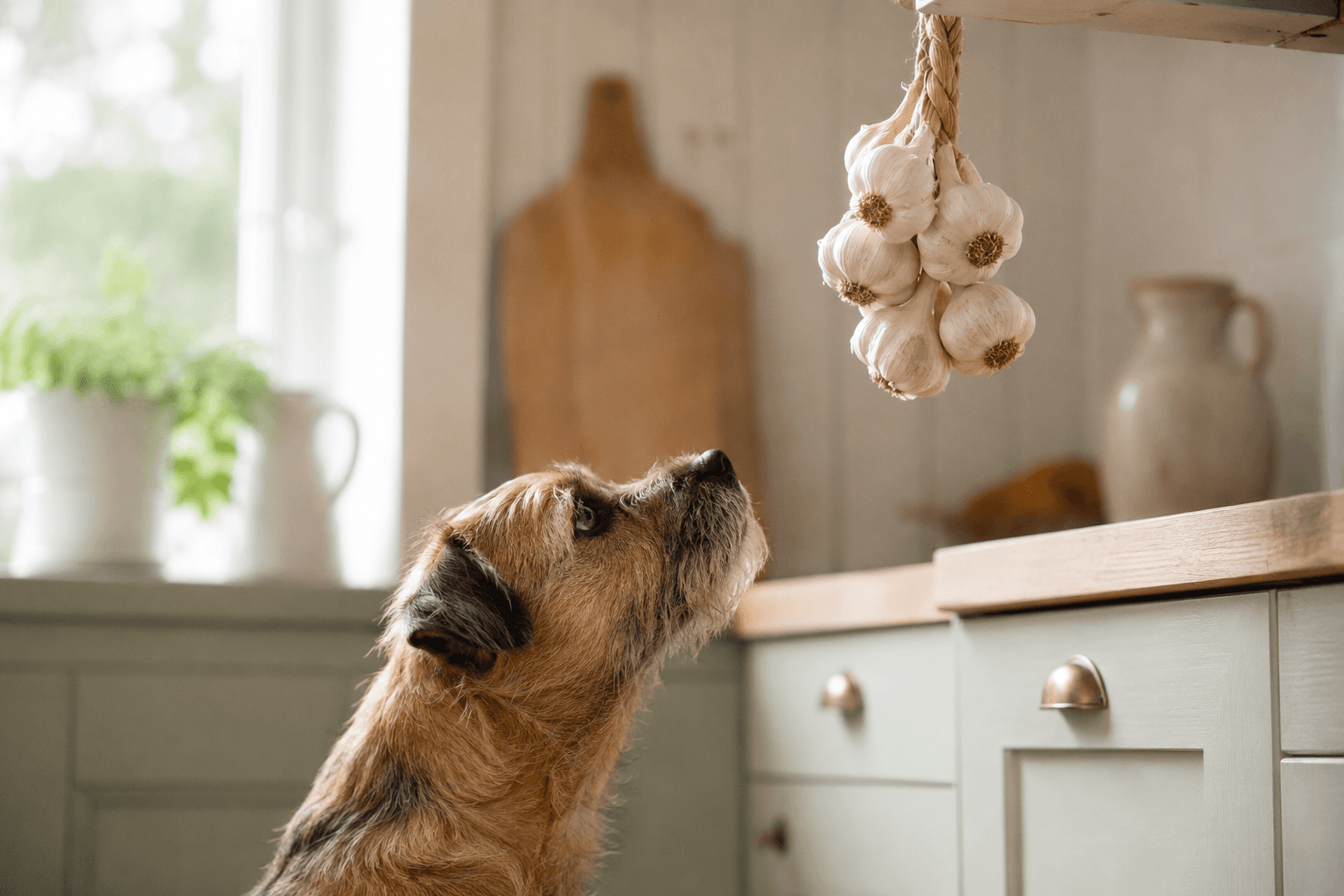
If your dog has eaten garlic
Ring your vet as soon as you know or suspect your dog has eaten garlic, even if it seems fine. Do not try to make your dog vomit at home; PDSA notes a vet may do this by injection if it is within four hours of eating. Note roughly how much and what form, fresh, cooked or powdered, since this affects treatment. Out of hours, Vets Now runs emergency clinics across the UK.
The detail
Garlic belongs to the allium family, along with onions, leeks and chives, and PDSA states that all parts of these plants are toxic to dogs, even when cooked or dried. The compounds responsible are disulphides and thiosulfinates, which PDSA says cause damage to red blood cells.
What makes garlic worth its own page rather than a footnote on the onion page is potency. VCA Animal Hospitals names garlic specifically as the most toxic of the four alliums commonly implicated in dog poisonings, meaning the same weight of garlic does more damage than the same weight of onion.
Form changes the dose without changing the danger. VCA explains that dried and powdered ingredients pack a higher concentration of the toxic compound per gram than the fresh version, because water content has been removed, and gives a concrete example: one teaspoon of garlic powder is equivalent to eight cloves of fresh garlic.
The damage happens at a cellular level. The compounds oxidise red blood cell membranes, making them fragile enough to burst, and once enough cells are destroyed the body cannot carry oxygen properly, which is what drives the more serious symptoms below.
Garlic by form
| Fresh garlic clove | Toxic in any meaningful amountVCA names garlic as the most toxic of the alliums |
| Garlic powder or granules | Far more concentrated than freshVCA: one teaspoon of powder equals eight cloves of fresh garlic |
| Cooked garlic (bread, sauces, stir-fries) | Just as toxic as rawPDSA: all forms are toxic, even cooked or dried |
| Garlic salt | Toxic, plus a separate salt riskCombines allium poisoning with excess sodium |
| Onset of symptoms | Within 24 hours, more often a few daysPDSA: anaemia signs can take 1 to 5 days to appear |
How much garlic is dangerous for a dog
None of the sources behind this page give a single safe amount, because sensitivity varies by dog, and VCA specifically names some breeds, including Akitas and Shiba Inus, as more sensitive than average. A stray fleck of garlic dropped from a chopping board is not the same event as a whole clove.
What is clear is that concentrated forms need far less to cause a problem. VCA's figure that one teaspoon of garlic powder equals eight fresh cloves means a seasoning shaker in reach of a small dog is a bigger risk than the same weight sitting in a fresh garlic bulb.
Body size matters too, in the same way it does for any toxin. A clove that a large Labrador shrugs off can be a genuinely dangerous dose for a five kilogram terrier, so err on the side of ringing your vet rather than weighing up whether the amount was small enough to ignore.
Garlic powder, granules and garlic salt
Powdered and granulated garlic are the forms most likely to end up eaten in a meaningful dose, since they are often sprinkled onto food, mixed into marinades, or spilled on a work surface a dog can reach. VCA's finding that powder is far more concentrated than the fresh clove by weight applies directly here.
Garlic salt adds a second toxin on top. PDSA and the Pet Poison Helpline both treat onion and garlic poisoning separately from salt poisoning, but a dog that licks up spilled garlic salt is getting a dose of both at once, which is worth mentioning to your vet.
Garlic-flavoured crisps, dips and seasoning mixes belong in this category too, since the flavour usually comes from powder rather than fresh cloves. Store these on a high shelf rather than a low cupboard a determined dog can nose open.
Garlic bread, garlic butter and takeaway food
Garlic bread, garlic mushrooms and garlic butter are common routes into a dog's mouth because they turn up at barbecues and on shared plates, and PDSA is explicit that cooked and processed garlic is just as toxic as raw. A slice or two of garlic bread grabbed off a plate is a real reason to call your vet, not something to shrug off because it was cooked.
Takeaway and restaurant food is harder to judge because you cannot see the ingredients list. If your dog has stolen a portion of a garlicky dish, treat it as a possible garlic exposure and ring your vet with your best estimate of how much was eaten.
Garlic-heavy sauces such as aioli, tzatziki and many curry bases are worth remembering too, since a small pot of dip disappears fast and carries a concentrated amount of garlic in a small volume of food.
My dog ate garlic. What should I do?
Ring your vet as soon as you know or suspect it, even if your dog seems completely fine. PDSA notes that symptoms can take a few days to appear after eating garlic, so a normal-looking dog on the day is not proof nothing happened.
PDSA describes the standard treatment: if it is within four hours of eating, your vet may give an injection to induce vomiting, and this should never be attempted at home. Activated charcoal, fluids on a drip, and blood tests to check for anaemia may follow, depending on the amount eaten and how your dog is doing.
Watch for vomiting, diarrhoea, reduced appetite and a sore tummy in the first day, then pale gums, tiredness or breathlessness over the following days, which PDSA links to the anaemia that develops as damaged red blood cells are cleared from the bloodstream.
Garlic supplements and the flea myth
Garlic is sometimes recommended online as a natural flea or worm treatment, and it is worth being direct about this: PDSA states plainly that there is no evidence garlic can treat fleas, and that it should never be given to dogs, even in small doses.
If you are looking for a natural-feeling approach to parasite prevention, that conversation belongs with your vet, not with a garlic clove. There is no dose of garlic that is both a genuine flea deterrent and safe for a dog to eat.
The same applies to human nutritional supplements that list garlic as an ingredient, which VCA Animal Hospitals notes can be a hidden source of exposure. Check the label of any joint, heart or general wellbeing supplement in the house before assuming it is fine for your dog just because it sits in a human vitamin bottle.
Signs to watch for
- Vomiting, diarrhoea or a sore, reluctant tummy in the first day
- Reduced appetite and drooling
- Pale or yellow gums, weakness or breathlessness over the following days
- Dark or red-tinged urine, which can point to red blood cell damage
- Rapid heart rate or collapse in more severe cases
Common questions
Is garlic poisonous to dogs?
Yes. PDSA lists garlic, alongside onions and leeks, as part of the allium family that is toxic to dogs in every form, raw, cooked or dried. VCA Animal Hospitals names garlic as the most toxic of that group.
How much garlic is dangerous for a dog?
There is no single safe amount, and sensitivity varies by dog, with VCA naming Akitas and Shiba Inus as more sensitive breeds. Concentrated forms need far less: VCA says one teaspoon of garlic powder equals eight cloves of fresh garlic.
My dog ate garlic bread. Should I worry?
Yes, ring your vet with an estimate of how much was eaten. PDSA is clear that cooked garlic is just as toxic as raw, so being baked into bread does not make it safer.
How long after eating garlic do symptoms show?
PDSA says symptoms can start within 24 hours but more commonly take a few days to appear, with anaemia-related signs like pale gums or tiredness showing 1 to 5 days after eating. A dog that seems fine on the day is not necessarily in the clear.
Can garlic treat fleas or worms in dogs?
No. PDSA states plainly that there is no evidence garlic can treat fleas, and that it should never be given to dogs, even in small doses.
Is garlic more dangerous than onion for dogs?
Yes. VCA Animal Hospitals identifies garlic as the most toxic member of the allium family that includes onion, leek and chive, meaning the same weight of garlic causes more harm.
What should I do if my dog eats a whole garlic bulb?
Ring your vet immediately rather than waiting for symptoms. This is a large dose relative to the amounts typically discussed in poisoning cases, and PDSA's standard treatment includes inducing vomiting within four hours if your vet judges it appropriate.