
My dog has eaten something: what to do
Updated 6 August 2026
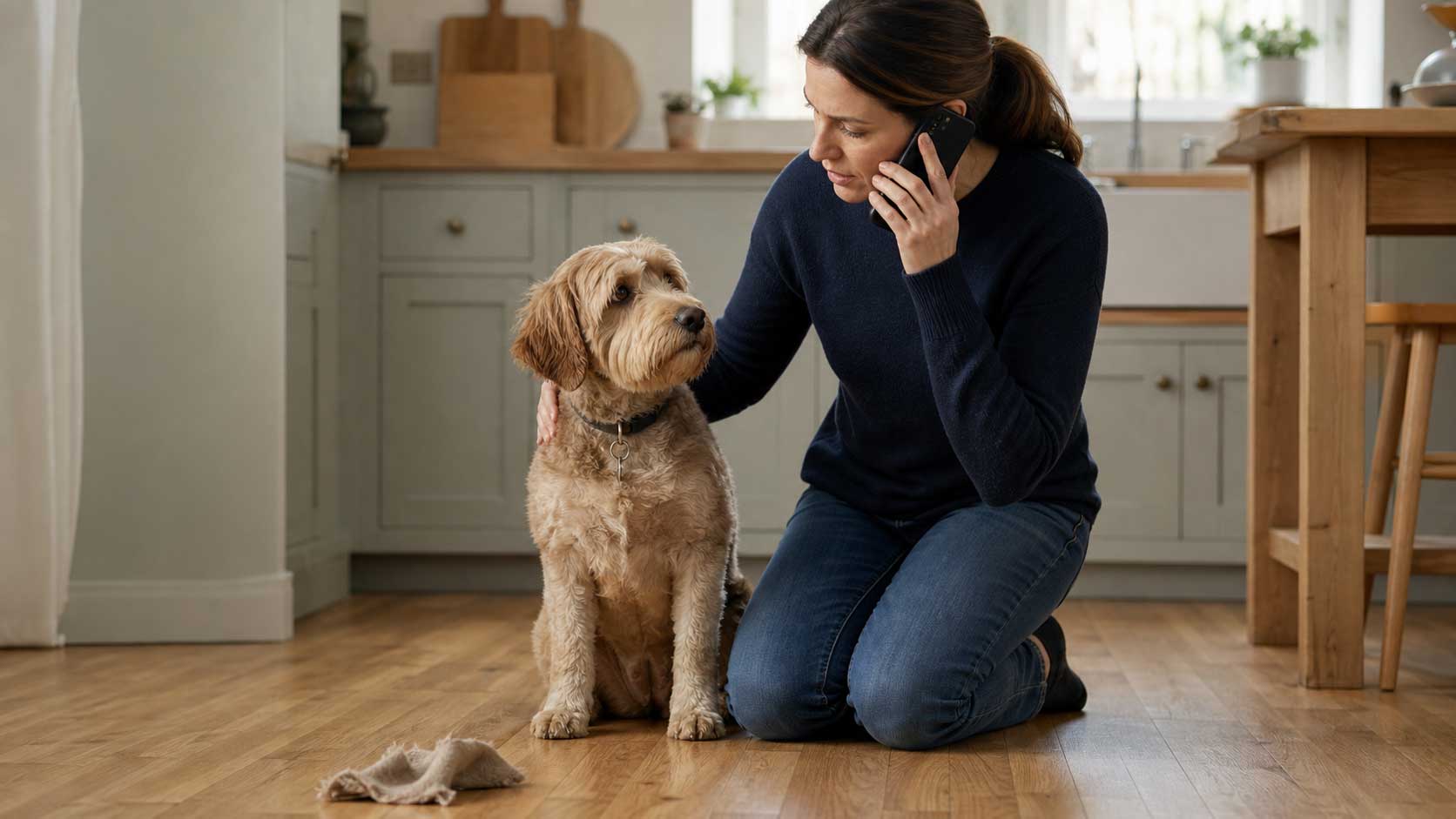
If your dog has eaten something and you are worried, ring your vet now and read this while you wait. Do not wait for symptoms, and do not try to make your dog sick unless a vet tells you to.
Do this now
- 1Ring your own vet first
During the day that is your practice. Out of hours, your practice's answerphone gives the emergency number, or use an out-of-hours service such as Vets Now. Advice over the phone costs nothing and takes two minutes.
- 2Take the packet with you
The wrapper, the label or the plant is the fastest way for a vet to work out what they are dealing with. Photograph it if you cannot bring it.
- 3Have three facts ready
Your dog's weight, what they ate and roughly how much, and when. Vets Now advises gathering the substance name, its strength and the amount, plus your dog's approximate weight, because the dose per kilo decides how serious this is.
- 4Do not make your dog sick
Vets Now is explicit: never induce vomiting unless you have been specifically directed to, because some substances do more damage coming back up than sitting in the stomach. Never use salt water, which is dangerous in its own right.
- 5Go straight in for the red flags
Collapse, convulsions or difficulty breathing means go to a vet immediately rather than making calls. The Animal PoisonLine says the same for adder bites, blue-green algae and inhaler incidents.
- Do this now
- Who to ring in the UK, and what it costs
- Signs worth acting on
- Chocolate: how much is actually dangerous
- Grapes and raisins: there is no safe amount
- Onion, garlic and where they hide
- Xylitol: the one most owners have never heard of
- What the vet will actually do
- The things that catch UK dogs out, by season
- Worth doing before anything happens
- Common questions
Who to ring in the UK, and what it costs
Your own vet is the first call and the free one. Every UK practice has an out-of-hours arrangement, so the number on the answerphone will reach someone at three in the morning.
The Animal PoisonLine is the second option, run by the Veterinary Poisons Information Service. It is the only 24-hour service in the UK dedicated to pet owners, and it is worth knowing that it charges: £35 for calls between 8am and 8pm on weekdays, and £45 at all other times including weekends and bank holidays.
That fee is money well spent if you cannot reach a vet, because VPIS holds the case database vets themselves ring for advice. It is not the number to try first if your practice is answering.
Signs worth acting on
Symptoms depend entirely on what was eaten, and some of the worst poisonings look like nothing at all for a day or two. Onion and garlic damage red blood cells over several days. Grapes and raisins can take 24 to 72 hours to show as kidney injury.
That delay is the single most important thing to understand. Your dog seeming fine an hour later tells you very little, which is why vets act on what was eaten rather than waiting to see.
- Vomiting or diarrhoea, especially repeated
- Drooling, or pawing at the mouth
- Wobbliness, tremors, twitching or seizures
- Unusual tiredness, weakness or hiding
- Pale gums, or gums that look grey or muddy
- Drinking or urinating much more or much less than usual
- A hunched posture or a tender belly
- Fast or laboured breathing
Chocolate: how much is actually dangerous
Chocolate is toxic because of theobromine, a stimulant dogs clear from their system far more slowly than people do. The darker the chocolate, the more theobromine per gram, which is why a small amount of baking chocolate is more serious than a larger amount of milk chocolate.
The MSD Veterinary Manual puts mild signs, restlessness and vomiting, at around 20mg of theobromine per kilo of your dog's weight. Heart effects start at 40 to 50mg per kilo, and seizures are possible from 60mg per kilo upward. Milk chocolate carries about 2.3mg of theobromine per gram, dark chocolate 5.3 to 5.6mg per gram, and high-cocoa baking chocolate around 15.5mg per gram, so the type matters as much as the amount.
White chocolate is the one exception: at roughly 0.04mg of theobromine per gram, it is a negligible source and not a poisoning risk on those grounds, though the sugar and fat can still upset a stomach.
| Chocolate type | Theobromine per 100g | Amount to reach mild signs, 10kg dog |
|---|---|---|
| White chocolate | About 4mg | Not a poisoning risk from theobromine |
| Milk chocolate | About 230mg | Around 90g, roughly two standard bars |
| Dark chocolate | 530 to 560mg | Around 35 to 38g, a few squares |
| Baking or high-cocoa chocolate | About 1,550mg | Around 13g, a small handful |
Grapes and raisins: there is no safe amount
Grapes, raisins, sultanas and currants are toxic to dogs and can cause kidney failure, and unlike chocolate there is no reliable dose that is known to be safe. Some dogs are poisoned by a handful, others tolerate more, and nobody can tell you in advance which dog is which.
That unpredictability is why every major veterinary source treats any amount as worth a call rather than quoting a safe number. Dried fruit is more concentrated per gram than fresh, so raisins in a hot cross bun or a slice of Christmas cake carry more risk than the same weight of fresh grapes.
Signs can take 24 to 72 hours to appear as kidney injury develops, so a dog that seems fine the same day has not necessarily got away with it.
Onion, garlic and where they hide
Onion and garlic, along with leeks and chives, damage a dog's red blood cells and can cause anaemia. The effect is cumulative and often delayed, sometimes not showing as pale gums, weakness or dark urine for a few days after eating.
The risk is less about a raw onion and more about where onion powder hides: gravy, stuffing, flavoured crisps, and pretty much anything from a Sunday roast or a Christmas dinner table. Cooking does not remove the toxin.
Xylitol: the one most owners have never heard of
Xylitol is a sweetener used in sugar-free gum, mints, some peanut butters, some baked goods and certain medicines. In dogs it triggers a rapid, dangerous drop in blood sugar, and in larger amounts it can cause liver failure, both faster and at a lower dose than most people expect.
Signs can start within 10 to 15 minutes of eating it: wobbliness, weakness and disorientation. This is one poisoning where speed genuinely matters more than with most others, so if you know or suspect xylitol, treat it as urgent and do not wait to see what happens.
What the vet will actually do
For a recent swallow, usually make your dog vomit under controlled conditions, then give activated charcoal to soak up what is left. This is routine and quick.
After that it depends on the substance. Fluids into a vein protect the kidneys after grapes or raisins. Blood tests track organ values over the following days. Some cases need nothing beyond monitoring at home with a phone number to ring.
Cost is the question nobody likes asking, so ask it early and plainly. A phone consultation is free, an out-of-hours emergency visit usually starts around £200 to £300, and a case needing two days of fluids and blood tests runs into four figures. This is the situation pet insurance exists for.
The things that catch UK dogs out, by season
Chocolate spikes twice a year, at Easter and Christmas, when it sits in stockings, egg boxes and advent calendars at exactly nose height. Raisins follow the same pattern through hot cross buns, mince pies and Christmas cake.
Onion is a year-round risk but peaks around Sunday roasts and Christmas dinner, hiding in gravy and stuffing rather than sitting on the plate as an obvious cube. Barbecue season brings its own version: corn cobs, skewers and cooked bones left within reach.
Worth doing before anything happens
Put your vet's number and the out-of-hours number in your phone now, under a name you will find while panicking. Add your dog's weight to the same contact note.
Know where the bin lives. A large proportion of poisoning cases are bin raids and counter surfing rather than anything exotic, and a bin behind a door solves most of them.
Common questions
What should I do if my dog eats chocolate?
Work out the type and roughly how much, then ring your vet with your dog's weight. Milk chocolate needs a larger amount to be dangerous than dark or baking chocolate, but any amount beyond a stolen crumb is worth a call rather than a guess.
How long does it take for poisoning symptoms to show in dogs?
It depends entirely on the substance. Some, like xylitol, act within 10 to 15 minutes, while others, like grapes or onion, can take 24 to 72 hours or even several days to show. A dog seeming fine soon after eating something tells you very little.
Is one grape dangerous to a dog?
Probably not, but nobody can promise that for your specific dog, because sensitivity varies unpredictably between individual dogs. Every major veterinary source advises treating any amount of grapes or raisins as worth a call to your vet.
Can I make my dog sick myself at home?
No, not without veterinary instruction. Some substances cause more damage coming back up than staying in the stomach, and home remedies like salt water are dangerous in their own right, so always ask a vet first.
How much does emergency vet treatment cost for poisoning in the UK?
A phone consultation with your own vet is free. An out-of-hours emergency visit typically starts around £200 to £300, and a case needing a couple of days of fluids and blood tests can run into four figures, which is exactly the situation pet insurance is designed for.
What if I do not know what my dog ate?
Ring your vet anyway and describe the signs you can see, plus anything you can rule in or out, like bins raided or packets found chewed. Vets can often narrow down the likely cause from symptoms and circumstances even without a confirmed substance.
Is xylitol worse than chocolate for dogs?
In some ways yes: xylitol acts faster, often within 10 to 15 minutes, and can be dangerous at a smaller amount than most owners expect. It is also less well known, which makes it the poisoning risk most likely to catch someone off guard.