
Can dogs eat ham?
Updated 6 August 2026
No, ham is not a food to give dogs. It is cured meat, which means salt in quantity and a fat load that can set off pancreatitis, and neither belongs in a dog's diet. One small piece will not poison a healthy dog, but there is no version of ham worth making a habit of.
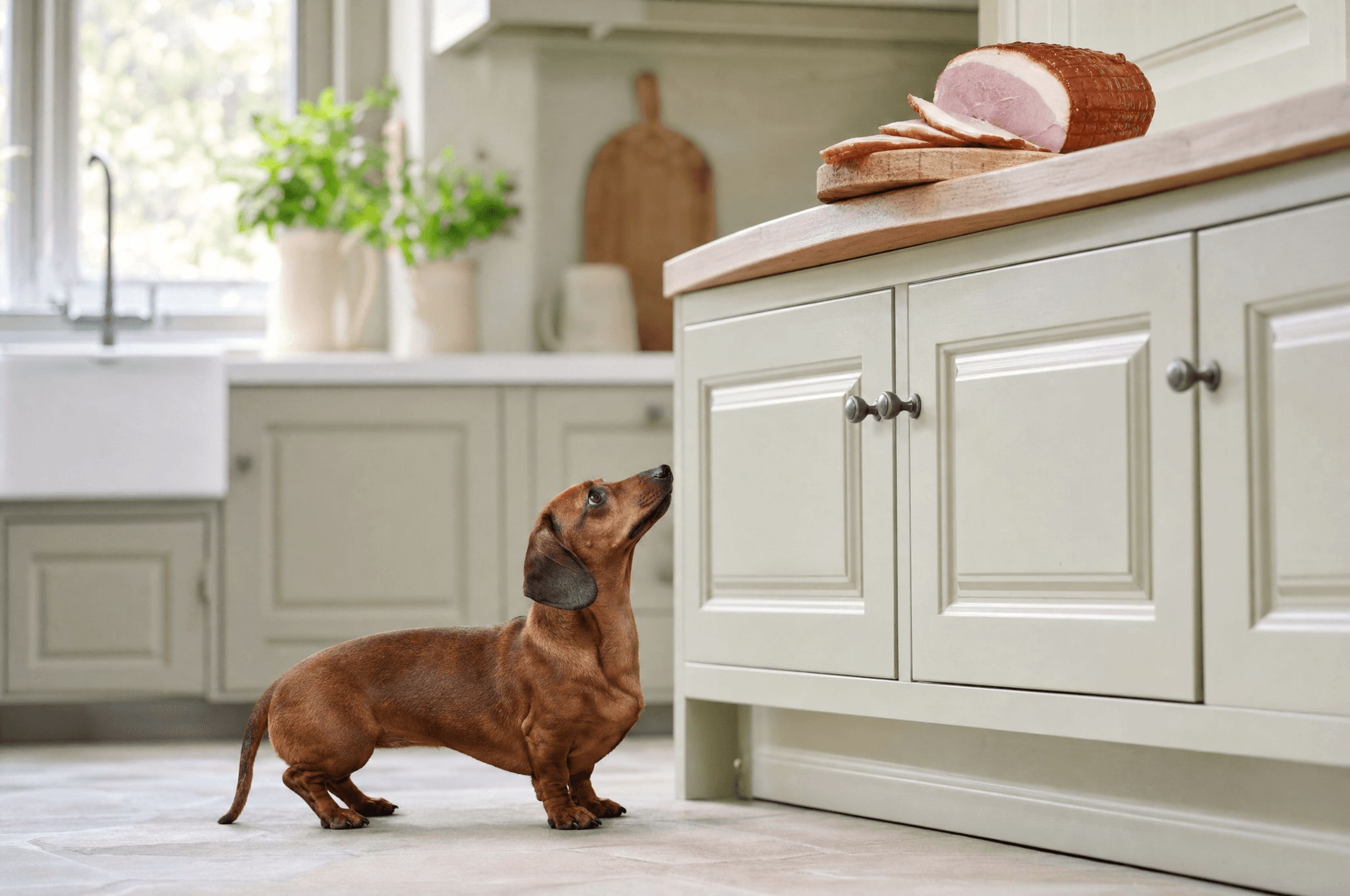
If your dog has eaten ham
A single slice needs nothing more than fresh water left down. Ring your vet if your dog has eaten a large amount, a whole joint, or any ham bone, and give your dog's weight and a guess at the quantity. Do not make your dog vomit unless a vet tells you to, particularly after a bone. Out of hours, Vets Now runs emergency clinics across the UK, and the Animal PoisonLine takes calls on 01202 509000.
The detail
Ham is pork cured with salt, and the curing is what separates it from plain roast pork. Supermarket cooked ham runs around 2g of salt per 100g, while fresh pork has almost none.
Salt poisoning takes a serious amount of ham. The MSD Veterinary Manual puts signs of salt toxicosis in dogs at around 2 to 3g of salt per kilo of body weight, so a 10kg dog would need roughly a kilo of ham in one sitting.
The realistic risk is the fat and the routine. Vets Now names scavenging and high-fat food among the common triggers for pancreatitis, and a dog on a low-sodium diet for heart or kidney disease has no room for cured meat at all.
Ham is also a habit food. A slice a day off the sandwich packet is how a spaniel ends up a stone overweight, and the begging that comes with it is harder to undo than the calories.
The salt and fat maths
| Salt in supermarket cooked ham | Around 2g per 100gFresh pork has almost none |
| A 20g slice | Roughly 0.4g of saltNot dangerous on its own, and not worth repeating |
| Fat in cooked ham | Around 5g per 100g, far more on the rind and fat cap |
| Salt toxicosis dose (MSD Veterinary Manual) | Around 2 to 3g of salt per kg of body weightA 10kg dog would need about a kilo of ham, which is why the everyday risk is fat and habit |
Cooked ham slices from the packet
This is the sandwich-ham question, and the honest answer is that one small piece will not poison a healthy dog. A 20g slice carries roughly 0.4g of salt, which is nowhere near a dangerous dose for a 10kg dog.
The problem is what it does as a habit. Ham is salty, fatty and calorie-dense, and a daily slice teaches a dog that the fridge door opening means food.
There is no dog that needs it. Plain cooked chicken does the same job for a training reward with a fraction of the salt.
Smoked ham and honey-roast ham
Smoked ham brings the cure plus whatever the smoking process added, and honey-roast adds a sugar glaze on top of the salt. Both are worse choices than plain cooked ham, not better ones.
Glazed joints also tend to be the fattiest, because the glaze sits on the fat cap. That fat is the part most likely to end in a vomiting dog at eleven at night.
Ham bones
No, and this one is firm. The Royal Kennel Club says all bones turn brittle when cooked and splinter easily, and splinters can obstruct the gut, irritate it or penetrate the stomach or intestinal wall, which may need surgery.
A ham hock or knuckle from a cooked joint is exactly the sort of bone that shatters. Our page on lamb bones covers the same problem and what to do if a bone has already been swallowed.
If your dog has taken a cooked bone, ring your vet rather than watching. Do not try to pull a bone back out of a dog's throat yourself.
Christmas leftovers and the bin raid
A cold ham or gammon joint on the counter on Boxing Day is one of the easiest thefts in the dog calendar. The trimmings, the rind and the fat cap all end up in the kitchen bin, which is the second target.
The Royal Kennel Club's Christmas advice is to keep meat out of reach and put carcasses and trimmings in an outside bin rather than the kitchen one. That single step prevents most of the festive pancreatitis cases vets see.
Our gammon page covers the joint itself, including the stock, the glaze and what a whole gammon means for a dog that gets to it.
My dog ate a lot of ham
Work out roughly how much and how fatty it was, then ring your vet with your dog's weight. A whole joint, a pile of trimmings or anything with bone in it is a call now rather than in the morning.
Watch for the salt signs first: heavy drinking, vomiting within a few hours, then weakness, diarrhoea or tremors if a large amount went down. The MSD Veterinary Manual describes that progression in salt toxicosis.
Pancreatitis shows up more slowly. Repeated vomiting, going off food, lethargy and a hunched back with the rear end up are the signs Vets Now describes, and they can appear a day or two after the meal.
Signs to watch for
- Heavy drinking and frequent urination after a salty amount
- Vomiting within a few hours
- Diarrhoea, weakness or muscle tremors after a large amount
- Refusing food, lethargy and a hunched back with the rear end raised, which suggests pancreatitis
- Straining, retching or a hard belly after a bone, which suggests an obstruction
Common questions
My dog ate one slice of ham. Should I worry?
No. A 20g slice holds roughly 0.4g of salt, which is far below a harmful dose for a healthy dog. Leave water down and do not repeat it.
How much ham is dangerous for a dog?
The MSD Veterinary Manual puts salt toxicosis signs at around 2 to 3g of salt per kilo of body weight, which for a 10kg dog is about a kilo of ham. Long before that, the fat can trigger pancreatitis, so ring your vet after any large or fatty amount.
Can dogs have ham bones?
No. The Royal Kennel Club says cooked bones turn brittle and splinter, and splinters can obstruct the gut or penetrate the stomach wall. If your dog has taken one, ring your vet rather than waiting.
Is honey-roast or smoked ham any different?
Both are worse than plain cooked ham. Honey-roast adds a sugar glaze to the salt, and glazed joints are usually the fattiest part of the leftovers.
My dog raided the Christmas ham. What are the signs to watch?
Heavy drinking and vomiting come first, then diarrhoea, weakness or tremors after a lot of salt. Pancreatitis appears more slowly as repeated vomiting, refusing food, lethargy and a hunched back, so ring your vet the same day rather than waiting it out.
Can puppies eat ham?
No. A puppy has less body weight to absorb the salt and a diet already balanced for growth. Plain cooked chicken is the training reward to use instead.