
Can dogs eat bacon?
Updated 6 August 2026
No, bacon is not a good thing to share. It is not poisonous, but it puts cured salt together with a lot of fat, and that pairing is one of the routes vets see into pancreatitis. A stolen rasher is unlikely to harm a healthy dog. Regular bacon sharing is a real risk.
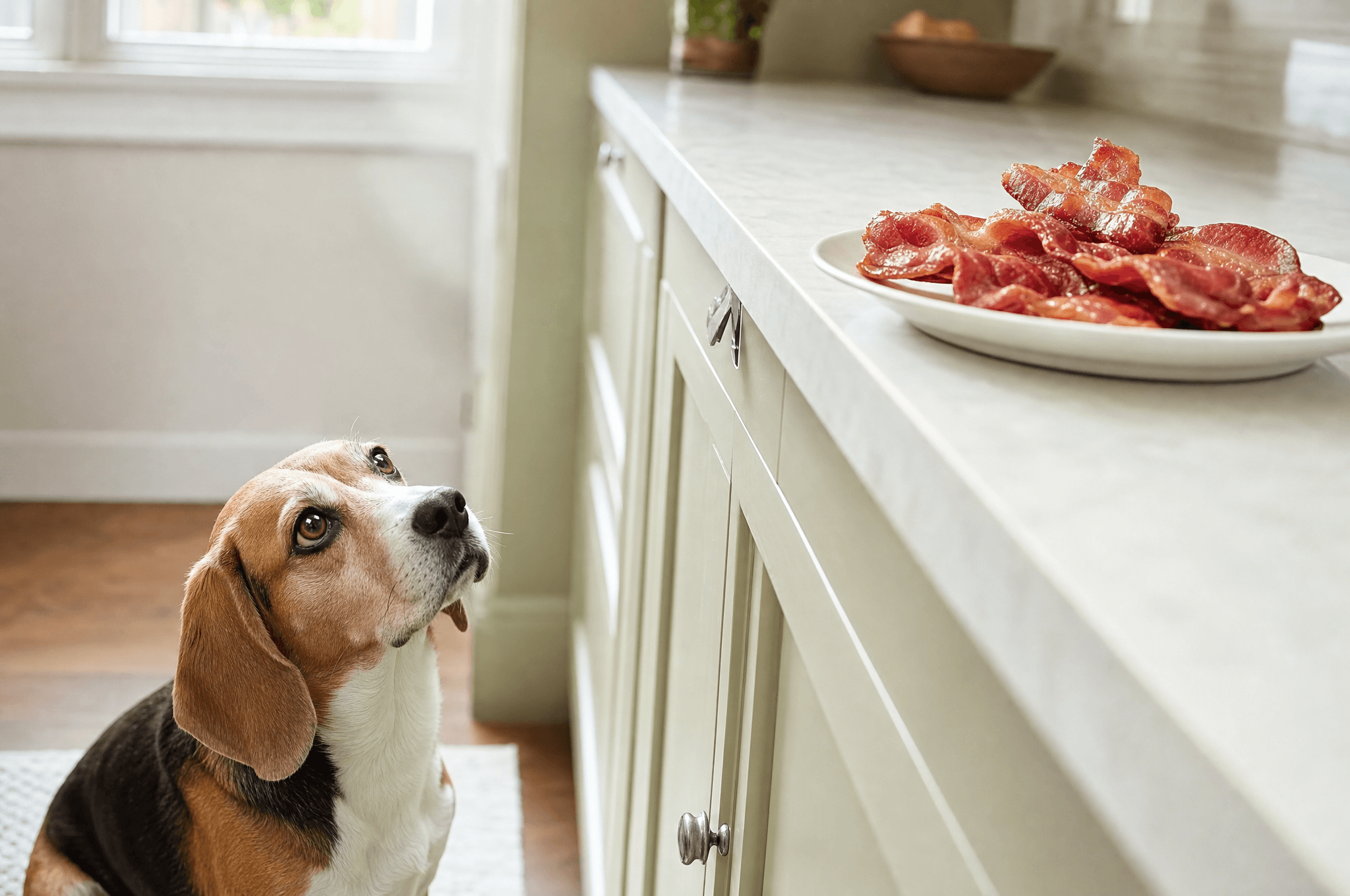
If your dog has eaten bacon
Ring your vet with your dog's weight and roughly how much bacon was eaten, and say whether it was raw or cooked. Do not make your dog vomit unless a vet tells you to. Out of hours, Vets Now runs emergency clinics across the UK, and the Animal PoisonLine takes owner calls on 01202 509000.
The detail
Bacon is pork belly or loin cured in salt, usually with nitrites, then either smoked or left unsmoked. The curing is the whole point of it, and salt is also the first reason it is a poor thing to put in a dog bowl.
Fat is the bigger problem. Vets Now lists scavenging and high-fat food among the most common risk factors for pancreatitis in dogs, and PDSA names recently eating high-fat foods, giving pork, cheese and butter as its examples, as something that raises the risk.
Pancreatitis is not a mild illness. It starts suddenly, it is painful, and PDSA says that without treatment it can cause severe illness and death. Treatment usually means fluids, pain relief and small low-fat meals until the dog is eating properly again.
The honest version is this. One small piece of cooked bacon will not poison a healthy adult dog, and pretending otherwise helps nobody. The dogs who end up in an emergency clinic are usually the ones who got a bit of everything, every weekend, for years.
What is in a rasher of bacon
| Salt in UK bacon | Typically 2 to 3g per 100g on supermarket labels |
| One grilled back rasher (about 25g) | Roughly 0.5g of saltHalf the reason bacon is a poor share |
| Fat in streaky bacon | Around 20g per 100g once cookedThe rind and the fat strip are the fattiest part of it |
| Anything toxic to dogs | NothingThe risk here is salt and fat, not a poison |
Can dogs eat cooked bacon?
One small bit of cooked bacon, once in a while, will not kill a healthy adult dog. That is worth saying plainly rather than treating a single crumb as an emergency.
It is still a poor habit to start. Every rasher brings salt and fat your dog has no use for, and a dog who learns that the frying pan means bacon will ask every time. Give the crumb, then stop; do not build it into the weekend.
Can dogs eat raw bacon?
No. Raw pork can carry Trichinella larvae, and the MSD Veterinary Manual advises treating pork as potentially infected unless it is labelled ready to eat. Thorough cooking or correct freezing is what deals with the parasite; curing in salt does not.
Raw bacon also carries the full cure salt load on top of the bacteria that cooking would have handled. If a slice goes missing from the pack, ring your vet with your dog's weight and how much was eaten.
Bacon fat, rind and pan drippings
This is the part to be firmest about. The rind, the fat strip along the edge and the grease left in the pan are close to pure fat, which is exactly what Vets Now and PDSA connect to pancreatitis.
Pouring bacon fat over a dog's dinner is a common kindness and a bad one. If you want to make dinner more interesting, a spoonful of plain cooked chicken does the same job with none of the risk.
Bacon sandwiches and full English leftovers
A cooked breakfast stacks the problem up. Bacon, sausage, fried bread and black pudding on one plate give a dog more fat in a single sitting than most manage in a week, and black pudding carries its own salt and fat load.
Buttered bread and brown sauce add nothing useful either. Battersea lists onions among the foods that are toxic to dogs, so fried onions on a plate are a separate problem again. When plates get scraped onto the floor, the fatty items are the ones to count.
My dog ate a packet of bacon
Ring your vet. A whole pack is a large dose of fat and salt in one go, and the details they will want are your dog's weight, roughly how many rashers, whether the bacon was raw or cooked, and what time it happened.
Do not make your dog vomit unless a vet tells you to. Over the next 48 hours watch for repeated vomiting, refusing food, a hunched back end or obvious belly pain, and treat any of those as a reason to be seen rather than a reason to wait.
Signs to watch for
- Repeated vomiting, often within a day of a fatty meal
- Loss of appetite and lethargy
- A hunched posture with the rear raised and the front legs down
- Diarrhoea, belly pain or a dog who does not want to be touched
Common questions
My dog stole one rasher of bacon. What should I do?
For a healthy adult dog, put fresh water down and watch them. Ring your vet if vomiting starts, if they refuse food, or if they stand hunched with the rear raised. Small dogs and dogs with a history of pancreatitis warrant a call sooner.
Can puppies eat bacon?
No. A puppy gets a much bigger relative dose of salt and fat from the same piece, and their food is already balanced for growth. There is nothing in bacon they need.
Is streaky or back bacon better for dogs?
Back bacon is leaner than streaky, but both are cured in salt so neither is a good share. If you are choosing between them for your dog, the better answer is plain cooked chicken.
Can dogs eat raw bacon?
No. The MSD Veterinary Manual advises treating pork as potentially infected with Trichinella unless it is labelled ready to eat, and curing does not kill the parasite. Raw bacon also carries the same salt as cooked.
My dog has bacon most weekends. Is that actually a problem?
It is the pattern vets worry about more than the one-off. Vets Now names high-fat food among the most common triggers of pancreatitis, and repeated fatty extras also add weight. Swap the routine for plain chicken or carrot and keep the habit, minus the risk.
What are the first signs of pancreatitis in a dog?
Vets Now lists vomiting, loss of appetite, diarrhoea, lethargy, belly pain and a hunched posture with the rear up and the front legs down. PDSA says the signs usually start suddenly and that not every dog shows all of them. Any of these after a fatty meal is a reason to phone.