
Can dogs eat mouldy food?
Updated 8 August 2026
No. Mouldy food is genuinely toxic to dogs, well beyond a case of an upset stomach. The MSD Veterinary Manual names penitrem A and roquefortine C, mycotoxins produced by Penicillium mould on spoiled food, as the cause of tremorgenic neuromycotoxicosis, which brings on tremors and seizures within hours. Bins, compost heaps and fallen fruit are the most common routes, and the Pet Poison Helpline and ASPCA both treat this as an emergency.
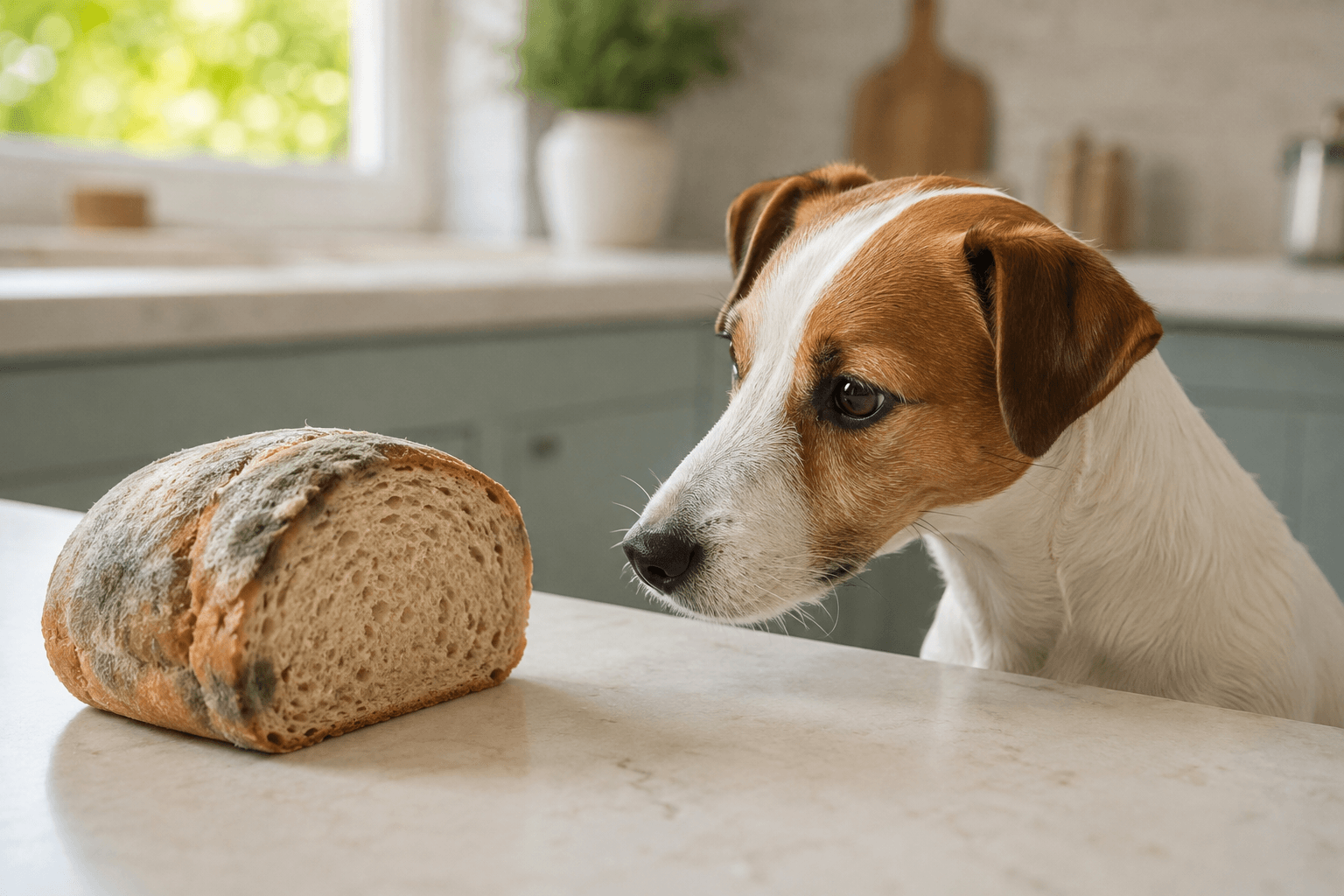
If your dog has eaten mouldy food
Ring your vet or the Animal PoisonLine straight away, since symptoms can start within a couple of hours. Try to work out what was eaten, roughly how much, and how long ago. Keep your dog calm and away from stairs or hard edges in case tremors start. Out of hours, Vets Now runs emergency clinics across the UK, and the Animal PoisonLine is on 01202 509000.
- The detail
- Signs and timeline of mycotoxin poisoning
- Dog ate mouldy bread
- Dog ate mouldy cheese
- Compost and garden waste
- Fallen fruit, conkers and nuts in autumn
- Is a mould-ripened cheese like blue cheese the same risk?
- My dog eats out of the compost or bin all the time and seems fine
- Better things to share
- Common questions
The detail
The danger is not mould in general but a specific group of toxins some Penicillium moulds produce as they grow on old food. The MSD Veterinary Manual names penitrem A, penitrem E and roquefortine C as the main tremorgenic substances involved, and describes penitrem A as disrupting normal nerve signalling in the brain, which is what causes the shaking and seizures rather than a straightforward tummy bug.
These toxins turn up wherever food has been left to spoil rather than in fresh mould-free food. The MSD Veterinary Manual lists walnuts, peanuts, dairy products, pasta and compost among common sources, and notes that a typical case history involves a dog running unsupervised and getting into a compost heap or discarded food waste, which describes most UK gardens and bins fairly precisely.
Onset is fast and the picture can escalate quickly. The MSD Veterinary Manual states that clinical signs can appear within a couple of hours of ingestion, and Pet Poison Helpline lists vomiting, agitation, tremors, seizures and a raised body temperature among the signs to watch for, warning that severe secondary effects can develop if the episode is left untreated.
PDSA's guidance on pet hazards puts it plainly: mouldy food can contain dangerous mycotoxins that are potentially fatal to dogs, and symptoms may start quickly, which is why a dog that has just raided the bin needs a call to the vet rather than a wait-and-see approach.
Signs and timeline of mycotoxin poisoning
| Toxins involved | Penitrem A and roquefortine CMSD Veterinary Manual |
| Common sources | Bread, cheese, pasta, nuts, compost, windfall fruit |
| Symptom onset | Can be within a couple of hours |
| Symptom duration untreated | Typically 24 to 48 hoursASPCA |
| Severity | Can be fatal without treatmentPDSA |
Dog ate mouldy bread
Bread that has gone green or fuzzy at the crust is a classic route to tremorgenic mycotoxin exposure, since bread is exactly the sort of starchy, damp food Penicillium mould grows on readily once it is past its best. A crust left in a bread bin, on a counter, or dropped and forgotten under a table is enough.
Do not scrape off the visible mould and assume the rest of the loaf is safe. The toxins the mould produces spread through the food well beyond the patch you can see, so any bread showing mould should go in a bin the dog cannot reach, not back on the side.
Dog ate mouldy cheese
Cheese that has gone off in the fridge, developing mould it was not meant to have, is a genuine mycotoxin risk and should be treated the same as mouldy bread. This is a different situation from deliberately mould-ripened cheeses, which sit in their own category below.
Ring your vet if a dog gets into cheese that has visibly spoiled, particularly if a reasonable amount has gone, and mention that it was mouldy specifically rather than just old.
Compost and garden waste
Compost heaps are named directly by both the MSD Veterinary Manual and the ASPCA as a common source of tremorgenic mycotoxin poisoning, since they are essentially a controlled pile of decomposing food, exactly the environment these Penicillium moulds grow best in.
A dog that free-ranges in a garden with an open compost heap has repeated, easy access to a genuine poisoning risk, so a secure bin with a lid the dog cannot lift is worth the investment, particularly for a food-motivated breed.
Fallen fruit, conkers and nuts in autumn
The ASPCA specifically names windfall fruit and nuts that have fallen from trees among the risks, and mouldy or fermenting apples, pears and walnuts under a tree are common in UK gardens and parks through the autumn, when fallen fruit has had time to sit and spoil on the ground.
Walnuts get a specific mention in the MSD Veterinary Manual's list of sources, so a walk under a walnut tree in October is worth keeping a dog on a lead for, particularly if there is a carpet of fallen nuts underneath.
Is a mould-ripened cheese like blue cheese the same risk?
This is a genuinely useful distinction. Roquefortine C, one of the two toxins the MSD Veterinary Manual names as the main cause of tremorgenic mycotoxicosis, is produced by Penicillium roqueforti, the same mould deliberately used to make Roquefort and other blue cheeses, which is where the toxin gets its name.
That does not mean every blue cheese is dangerous in a normal kitchen amount, since commercial production is controlled, but it does mean blue cheese is not automatically safer than an accidentally spoiled cheese just because its mould was intentional. Treat any real quantity of blue cheese as a food to keep away from dogs, and see our blue cheese page for portion-specific guidance.
My dog eats out of the compost or bin all the time and seems fine
A dog that has raided the bin before without visible symptoms has likely had either a smaller dose or food that had not yet developed a dangerous level of toxin, not proof that the habit is safe. Mould growth and toxin concentration vary from one piece of food to the next, so a bin raid that caused nothing last month can be different from the one today.
The MSD Veterinary Manual's point that symptoms can appear within a couple of hours means a dog that seems fine straight after raiding the bin is not necessarily in the clear yet. Watch closely for a few hours after any bin or compost raid rather than assuming a clean track record predicts this one.
Signs to watch for
- Vomiting and drooling
- Agitation or unsteady, drunken-looking movement
- Muscle tremors or full seizures
- A raised body temperature
Common questions
My dog ate a small bit of mouldy bread. Is that an emergency?
Ring your vet to check, since the MSD Veterinary Manual notes symptoms can start within a couple of hours of ingestion. Even a small piece is worth mentioning, as the mould's toxin level can vary from one piece of food to the next.
What are the signs of mould poisoning in dogs?
Pet Poison Helpline lists vomiting, agitation, tremors, seizures and a raised body temperature. These can appear within a couple of hours of a dog eating mouldy food, so watch closely rather than waiting overnight.
Is it safe to just cut the mould off and give the rest?
No. The toxins produced by Penicillium mould spread through food beyond the visible patch, so removing the mouldy bit does not make the rest of the item safe to feed.
Are compost heaps really that dangerous for dogs?
Yes. Both the MSD Veterinary Manual and the ASPCA name compost specifically as a common source of tremorgenic mycotoxin poisoning, since it is a pile of decomposing food exactly where these moulds thrive.
Is blue cheese as dangerous as accidentally mouldy cheese?
The same family of mould is involved, since Penicillium roqueforti, used to make blue cheese, produces roquefortine C, one of the toxins named by the MSD Veterinary Manual. A large amount of any blue cheese is worth avoiding, even though commercial production is controlled.
How long do symptoms of mould poisoning last?
The ASPCA states that symptoms typically last 24 to 48 hours, and it can be life-threatening without treatment, so veterinary care matters even if a dog seems to be settling on its own.
Can puppies eat mouldy food?
No. Puppies are smaller, so the same amount of toxin is a bigger relative dose, and their curiosity around bins and compost tends to be higher, not lower, than an adult dog's.