
Can dogs eat blue cheese?
Updated 8 August 2026
No, treat blue cheese as unsafe for dogs. The Penicillium mould that gives Stilton, Roquefort and Gorgonzola their veins also produces roquefortine C, and blue cheese sits high among the dairy products vets name as sources of tremorgenic mycotoxin poisoning, a condition that can cause tremors and seizures. It is also usually high in salt and fat, on top of the mould risk.
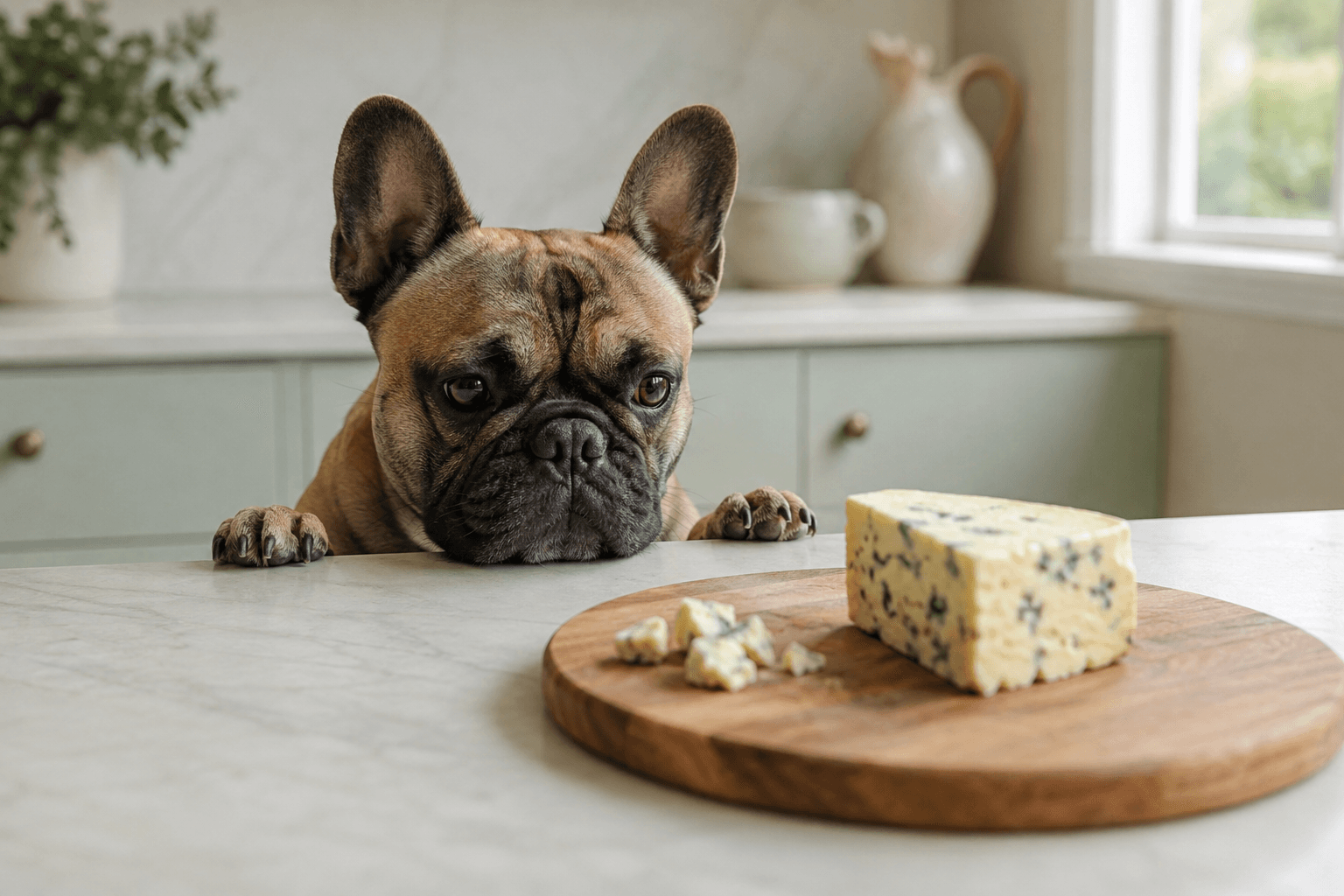
If your dog has eaten blue cheese
Call your vet straight away if your dog has eaten more than a small crumb of blue cheese, and mention the type and roughly how much. Do not wait for symptoms before ringing, since tremors can start within one to two hours. If you see tremors, twitching or a seizure, keep your dog somewhere safe and quiet and get to a vet immediately.
- The detail
- Roquefortine C in blue cheese, by origin (2020 retail study)
- Is a small crumb of blue cheese actually dangerous?
- My dog ate a piece of Stilton, what should I do?
- Can dogs have Roquefort or Gorgonzola instead of Stilton?
- Is regular mouldy cheese as risky as blue cheese?
- Are plain cheeses like mozzarella or cheddar a safer swap?
- Better things to share
- Common questions
The detail
Blue cheese gets its flavour and its veining from Penicillium mould cultures deliberately introduced during production, and that same mould family produces a group of compounds called tremorgenic mycotoxins, including penitrem A and roquefortine C. A 2020 study testing 46 retail blue cheeses found roquefortine C in every single sample, with English Blue Stilton showing the highest average levels of any origin tested.
The veterinary picture on roquefortine C specifically is more nuanced than a lot of pet sites suggest. The MSD Veterinary Manual notes that roquefortine C on its own has shown limited tremorgenic activity in animal studies, and that many suspected roquefortine C poisoning cases were never tested for penitrem A, a much more potent tremorgen that is often produced alongside it by the same mould. In practice, a dog eating mould-affected dairy is rarely exposed to just one isolated toxin.
Real veterinary cases of tremorgenic mycotoxin poisoning in dogs are documented, and dairy products are named among the typical sources, alongside mouldy bread, nuts and compost. A published case report describes an eleven-year-old dog developing seizures, facial twitching and loss of coordination after raiding a compost pile, with penitrem A, roquefortine C and paxilline all confirmed in its vomit, which shows how these toxins commonly turn up together rather than alone.
On top of the mould question, blue cheese is one of the saltier, fattier cheeses on a UK cheeseboard, and a rich, fatty dairy food is also a plausible trigger for a bout of pancreatitis in a sensitive dog, quite apart from any mycotoxin risk. Between the mould, the salt and the fat, there is no good reason to offer it deliberately.
Roquefortine C in blue cheese, by origin (2020 retail study)
| English Blue Stilton | Mean 3,675 µg/kgHighest of the origins tested, up to 5,454 µg/kg |
| Danish blue cheese | Mean 1,051 µg/kg |
| Italian blue cheese | Mean 836 µg/kg |
| Polish blue cheese | Mean 439 µg/kg |
| French blue cheese | Mean 396 µg/kgLowest of the origins tested, as low as 3.2 µg/kg in some samples |
Is a small crumb of blue cheese actually dangerous?
A single small crumb dropped and hoovered up is unlikely to cause a dramatic reaction in most dogs, and the honest answer is that no dog-specific toxic dose for roquefortine C has been established. That is different from saying it is fine, since it simply means nobody has defined a safe amount.
The safer approach is to treat any blue cheese as something to keep away from a dog on purpose, the same way you would with an unknown mushroom, rather than deciding a small amount is a reasonable treat. If a dog does eat a larger piece, that is when to call your vet.
My dog ate a piece of Stilton, what should I do?
Call your vet, especially with Stilton specifically, since the 2020 cheese study found English Stilton carried the highest roquefortine C levels of any blue cheese origin tested, well above French, Italian or Danish varieties in the same sample set.
Watch for vomiting, drooling, tremors, twitching or unsteadiness over the following few hours, since the MSD Veterinary Manual notes tremorgenic mycotoxin signs can begin within one to two hours of ingestion. Do not wait for symptoms if a meaningful amount was eaten, ring your vet straight away.
Can dogs have Roquefort or Gorgonzola instead of Stilton?
The same caution applies to any blue-veined cheese, since Roquefort and Gorgonzola use closely related Penicillium mould strains to Stilton, and the 2020 study found measurable roquefortine C in French, Italian, Danish and Polish blue cheeses as well as English ones, just at somewhat lower average levels.
There is no blue cheese variety that avoids the mould entirely, since the veining and the flavour it creates are the same process that produces the mycotoxins. Treat all blue-veined cheeses the same way.
Is regular mouldy cheese as risky as blue cheese?
Any cheese that has gone off and grown unintended mould is a similar or greater risk, not a lesser one, since Pet Poison Helpline groups all moulded dairy products together as a mycotoxin risk, without distinguishing deliberately cultured blue cheese from cheese that has simply spoiled.
A block of cheddar with an unexpected patch of mould has not been through the controlled fermentation blue cheese uses, so it is not automatically safer, it is simply a different, less predictable source of the same broad problem. Bin any mouldy cheese rather than offering scraps to a dog.
Are plain cheeses like mozzarella or cheddar a safer swap?
Yes, plain, non-blue cheeses such as mild cheddar, mozzarella or a low-salt cottage cheese do not carry the mycotoxin risk, since they are not made with the same mould cultures. They still bring fat and, in many cases, salt, so a small amount remains the rule.
Watch out for lactose sensitivity too, since VCA Animal Hospitals' guidance on food intolerance in dogs notes that dogs vary in how much lactase they produce, and dairy can cause loose stools or wind even in dogs with no allergy at all.
Signs to watch for
- Vomiting, drooling or agitation within a few hours of eating
- Muscle tremors, twitching or shaking
- Loss of coordination or wobbliness
- Seizures in more serious cases
- A raised body temperature
Common questions
Is a tiny crumb of blue cheese going to poison my dog?
A small accidental crumb is unlikely to cause a serious reaction in most dogs, but there is no established safe dose, so it is not something to offer on purpose. Watch for any vomiting, tremors or unsteadiness over the following hours regardless.
Which is worse for a dog, Stilton or another blue cheese?
A 2020 retail study found English Stilton had the highest average roquefortine C levels of the blue cheeses tested, ahead of Danish, Italian, Polish and French varieties, though all of them contained the toxin.
What is roquefortine C exactly?
It is a mycotoxin produced by the Penicillium mould used to make blue cheese. The MSD Veterinary Manual notes its individual tremorgenic potency is less well established than penitrem A, a related toxin often produced by the same mould.
How fast do symptoms show up after a dog eats blue cheese?
Tremorgenic mycotoxin signs can begin within one to two hours of ingestion, according to the MSD Veterinary Manual, though it can take longer depending on the amount eaten.
Is plain cheddar or mozzarella safer than blue cheese?
Yes, non-blue cheeses do not carry the mycotoxin risk since they are not made with the same mould cultures. They still bring fat and salt, so keep portions small regardless.
Can dogs eat cheese that has gone mouldy by accident?
No, treat any unintentionally mouldy cheese as a similar or greater risk than blue cheese, since Pet Poison Helpline groups all moulded dairy together as a mycotoxin source. Bin it rather than offering scraps.
Should I make my dog vomit after eating blue cheese?
Do not do this at home without veterinary advice. Call your vet first and let them decide, since inducing vomiting is not always the right response and timing matters.