
Can dogs eat cheese?
Updated 5 August 2026
In small amounts, yes. Most cheese is not toxic to dogs, but it is dense in fat and salt, and many adult dogs handle lactose badly. A pea-sized cube works well as a training treat. Blue cheeses like stilton are the exception: they are genuinely dangerous and belong on the no list.
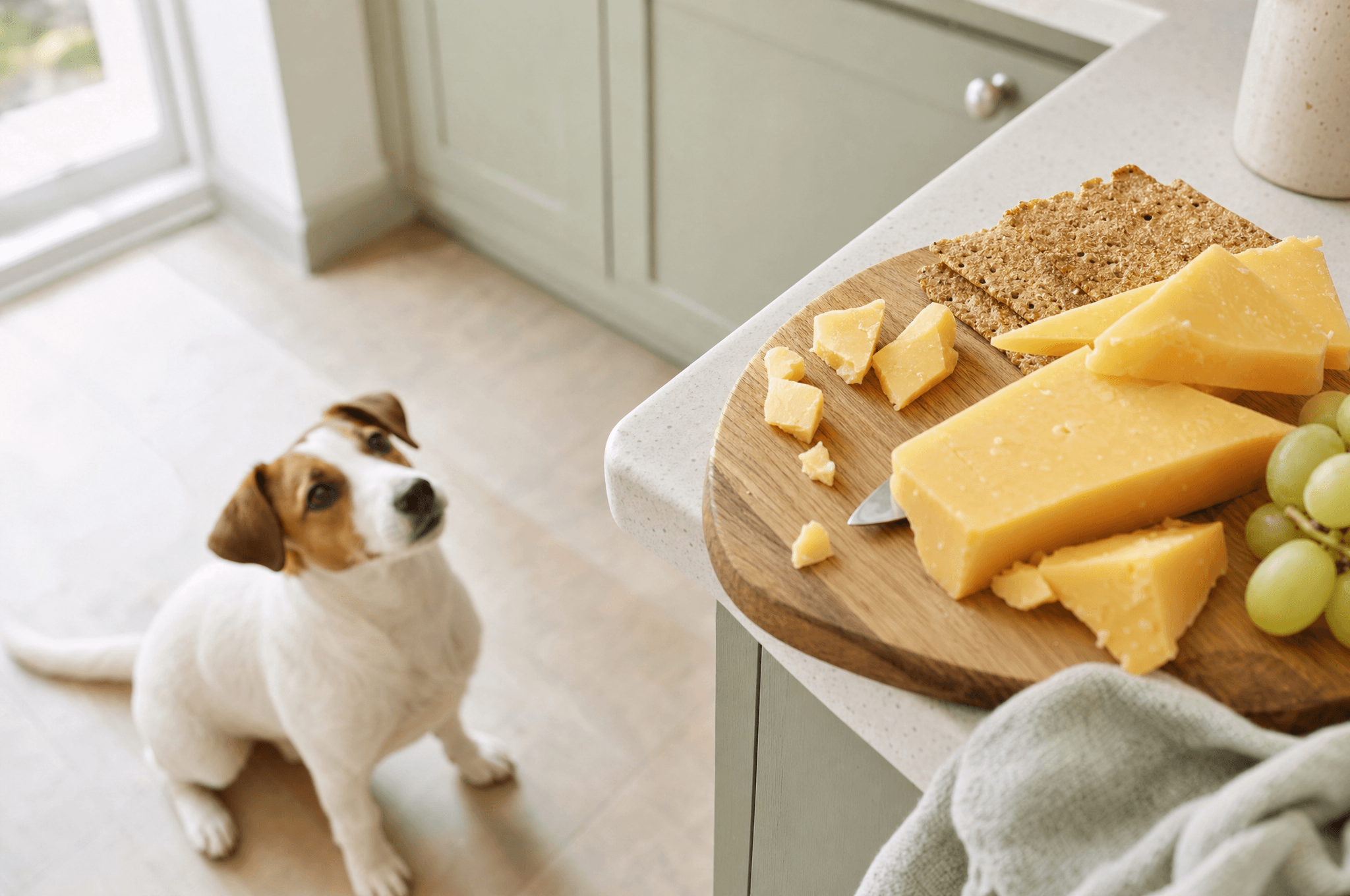
The detail
Cheese sits in the amber category because the problem is the dose, not the ingredient. A tiny cube of cheddar is a training reward most dogs will do anything for. A regular wedge habit is a fat and salt load that shows up on the scales and, in unlucky dogs, as pancreatitis.
Cheddar runs at roughly 35g of fat and 1.8g of salt per 100g. That is why the portion advice on this page is measured in peas, not slices.
One family of cheeses breaks the amber rule entirely. Blue cheeses carry roquefortine C, a substance dogs are notably sensitive to, and they get their own warning section below.
The fat and salt maths
| Fat in cheddar | Around 35g per 100g |
| Salt in cheddar | Around 1.8g per 100g |
| A pea-sized cube (about 3g) | Roughly 1g of fat, 0.05g of saltThe sensible training-treat size |
| One cheese string (20g) | Around 0.5g of saltA lot for a small dog in one go |
| Blue cheese (stilton, Roquefort) | Contains roquefortine C. No safe amountTremors and seizures reported; ring your vet |
How much is sensible
| Dog size | Sensible amount |
|---|---|
| Small (under 10kg)Chihuahua, Jack Russell | One or two pea-sized cubes in a training session, a few days a week |
| Medium (10 to 25kg)Cocker spaniel, border collie | Two or three pea-sized cubes, a few days a week |
| Large (over 25kg)Labrador, German shepherd | A dice-sized cube, chopped small, a few days a week |
| Overweight dogs, or any dog with pancreatitis history | None. The fat is exactly what their diet restricts |
Cheddar and hard cheeses
Hard, aged cheeses like cheddar, Red Leicester and parmesan are the least-bad choices. Ageing removes most of the lactose, so they sit easier on dogs that milk would upset.
The fat does not age away. Cheddar is still around a third fat by weight, so low lactose is a reason to prefer cheddar over soft cheese, never a reason to share more of it.
Cheese as a training treat and pill pocket
Used sensibly, cheese is one of the most effective tools in dog training. It is high value, smells strong and breaks into tiny pieces, and a pea-sized cube is enough for a dog to work for.
It is also the classic pill hider, and a wrapped tablet often goes down where a plain one is refused a dozen times. Check with your vet first though: some medicines should not be given with dairy, and dogs on fat-restricted diets need a different wrapper, such as a bit of banana.
The habit to avoid is grating cheese over dinner. That turns a training tool into a daily fat dose, and dogs will happily hold out for it once it becomes routine.
Can dogs eat blue cheese?
No. Blue cheeses are made with a fungus, and the Kennel Club warns they contain roquefortine C, a substance that can cause muscle tremors and seizures in dogs lasting up to two days. Vets Now adds vomiting, diarrhoea and a high temperature to the list of signs.
In the UK the usual route in is stilton at Christmas, either from the cheeseboard or a rind in the bin. Treat a raided cheeseboard as a vet call, with a guess at how much stilton went missing.
Mouldy cheese from the bin carries a related risk. The Pet Poison Helpline lists mouldy dairy among the foods behind tremorgenic mycotoxin poisoning, so bin-raiders need a secure lid year round.
Cheese strings and processed slices
Processed cheese products swap some fat for salt and additives. A single cheese string carries around 0.5g of salt, which is a meaningful dose for a small dog in one snack.
Nothing in a plain processed slice is toxic, so a stolen one is a shrug rather than an emergency. As a deliberate treat, a pea of real cheddar beats a processed product on every count.
Lactose intolerant dogs
Many adult dogs lose the enzyme that digests lactose after puppyhood, which is why milk so often ends in loose stools. Cheese carries much less lactose than milk, and hard aged cheese the least of all.
Even so, some dogs react to any dairy. If cheese reliably produces a soft stool or a gurgling stomach by evening, that dog has told you its answer, and chicken or carrot makes a better training treat.
Signs to watch for
- Loose stools or wind within a day, the usual lactose reaction
- Vomiting, tremors, twitching or wobbliness after blue cheese
- Repeated vomiting and a tender tummy after a large fatty haul, which can mean pancreatitis
If your dog overdoes it
A stolen cube of cheddar needs nothing beyond fresh water. If your dog has eaten blue cheese, or a large amount of any cheese, ring your vet with your dog's weight and a guess at the quantity. Out of hours, call Vets Now or the Animal PoisonLine on 01202 509000.
Common questions
My dog ate stilton off the cheeseboard. What do I do?
Ring your vet with your dog's weight and a guess at the amount. Blue cheeses contain roquefortine C, which can cause tremors and seizures in dogs. Do not wait to see how they seem.
Can dogs eat cream cheese?
A thin smear is fine for most dogs, and it is a common way to load a lick mat. It carries more lactose than hard cheese, so start tiny and skip it for dogs that dairy upsets.
Can dogs eat cheese and onion crisps?
No. The onion flavouring is the problem, because onion in any form is toxic to dogs, and the salt does no favours either. One dropped crisp is very unlikely to cause harm, but do not share the bag.
Is cheese bad for dogs with kidney or heart disease?
Yes, skip it for them. Those dogs are usually on restricted-sodium diets, and cheese works directly against that. Ask your vet for treat options that fit the diet.
Can puppies have cheese?
Tiny amounts are generally fine and many trainers use it, since puppies still produce the enzyme that digests lactose. Keep pieces pea-sized or smaller and stop if stools go soft.
Which cheese is safest for dogs?
Hard aged cheeses like cheddar in pea-sized amounts, since ageing removes most of the lactose. Avoid all blue cheeses and anything with added onion, garlic or chives, and keep every cheese occasional.