
Can dogs eat soy sauce?
Updated 8 August 2026
No, soy sauce is unsafe for dogs and should not be added to their food or shared from your plate. A single tablespoon carries around 879mg of sodium, several times a dog's daily requirement, and the MSD Veterinary Manual puts the dose linked to salt-toxicosis symptoms at just 2 to 3 grams of salt per kilogram of body weight. Small dogs and repeated exposure are the real danger.
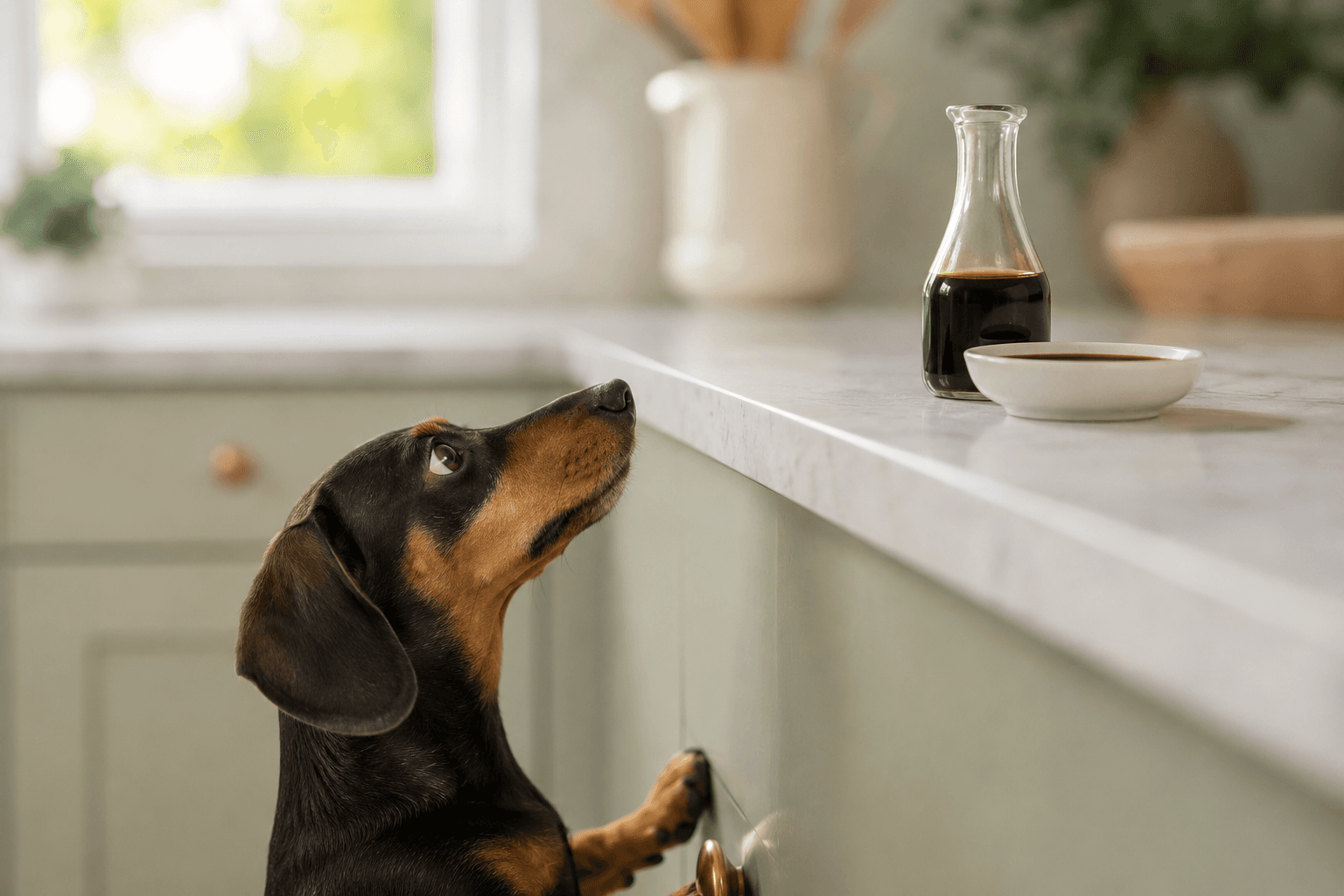
If your dog has eaten soy sauce
Call your vet straight away if your dog has drunk from a bowl of soy sauce, a dipping dish, or eaten a takeaway container with a meaningful amount left in it, and tell them roughly how much and your dog's weight. Make sure fresh water is available while you wait for advice, since hydration is central to managing salt exposure. Do not try to treat vomiting, tremors or disorientation at home, these need a vet.
- The detail
- Soy sauce sodium and dog salt-toxicosis thresholds
- How much soy sauce is actually dangerous for a dog?
- Is a small splash of soy sauce in my dog's rice okay?
- What about low-sodium or light soy sauce?
- My dog drank from a bowl of soy sauce or a dipping dish, what now
- Are other salty sauces like fish sauce or teriyaki just as risky?
- Does soy sauce ever end up hidden in homemade dog treats or table scraps?
- Better things to share
- Common questions
The detail
Soy sauce is essentially fermented soybeans, wheat and a large amount of salt, and salt is the entire reason this page exists. A single tablespoon of regular soy sauce carries around 879mg of sodium, the equivalent of roughly 2.2 grams of salt, based on USDA-sourced nutrition data. That is a small splash in a stir-fry for a person, but it is a meaningfully large sodium dose relative to a dog's size. In the UK it also shows up in the small sachets and dipping pots that come with a Chinese or Japanese takeaway, exactly the kind of thing that ends up on the floor or in an easily reached bin after a meal.
For comparison, veterinary nutrition guidance from the NRC puts a healthy adult dog's minimum daily sodium requirement at around 13.3mg per kilogram of body weight, reported in a Vet Times article on sodium in canine diets. For a 10kg dog, that works out to roughly 133mg a day, meaning a single tablespoon of soy sauce is more than six times that dog's entire daily requirement in one go, even before counting the sodium already in their normal food.
The MSD Veterinary Manual's entry on salt toxicosis gives the numbers that matter for a genuine emergency: clinical signs of toxicosis can appear from around 2 to 3 grams of sodium chloride per kilogram of body weight, and the acute oral lethal dose in dogs is roughly 4 grams per kilogram. Working through the maths, that puts the toxicosis threshold for a 10kg dog at somewhere around 9 to 13 tablespoons of soy sauce, and the lethal dose at closer to 18 tablespoons. That sounds like a lot for a small splash in cooking, but it is well within reach of a dog that gets into a bottle, a bowl of soy-based dipping sauce, or a takeaway container left within reach, and a much smaller dog needs proportionally less to reach the same danger point.
It is worth being fair to the numbers here too. A Vet Times review of the veterinary literature on canine sodium needs found no strong evidence that dietary sodium levels are linked to blood pressure in healthy dogs, or that ordinary salt intake speeds up kidney or heart disease in dogs without those conditions already. That does not make soy sauce a safe food to add on purpose. It is concentrated sodium with none of a dog's nutritional needs met, and dogs who already have heart, kidney or liver disease are usually on vet-prescribed low-sodium diets specifically because their situation is different from a healthy dog's.
Soy sauce sodium and dog salt-toxicosis thresholds
| Sodium per tablespoon of soy sauce | Approx. 879mg (about 2.2g of salt)USDA-sourced retail figure; reduced-sodium versions run lower |
| NRC minimum daily sodium requirement | Approx. 13.3mg per kg of body weightAbout 133mg a day for a 10kg dog |
| Dose linked to salt-toxicosis signs | 2 to 3g of sodium chloride per kg of body weightRoughly 9 to 13 tablespoons of soy sauce for a 10kg dog |
| Dose considered potentially lethal | Approx. 4g of sodium chloride per kg of body weightRoughly 18 tablespoons of soy sauce for a 10kg dog |
How much soy sauce is actually dangerous for a dog?
Working from the MSD Veterinary Manual's figures, clinical signs of salt toxicosis can start at around 2 to 3 grams of sodium chloride per kilogram of body weight, which works out to roughly 9 to 13 tablespoons of regular soy sauce for a 10kg dog, or proportionally less for a smaller one. The acute lethal dose sits around 4 grams per kilogram, closer to 18 tablespoons for that same 10kg dog.
Those numbers sound reassuring until you picture the real-world scenario: a small dog getting into a bottle left on a low counter, drinking from a bowl of soy-based dipping sauce, or finishing a discarded takeaway carton. None of those require careful measuring, and a toy breed needs far less than a labrador to reach the same danger point.
Is a small splash of soy sauce in my dog's rice okay?
It is not something to do on purpose. Even a teaspoon of soy sauce, at around 290mg of sodium, comfortably exceeds a small dog's entire daily sodium requirement in one go, based on the NRC's minimum intake figures reported by Vet Times, and it adds nothing nutritionally that plain rice or plain chicken does not already provide.
A genuinely accidental taste, a dog licking a spoon or a splash on the floor, is very unlikely to cause the kind of emergency covered by the toxicosis numbers above. The sensible approach is simply not to season a dog's food with soy sauce at all, rather than trying to judge a safe splash.
What about low-sodium or light soy sauce?
Reduced-sodium soy sauce typically carries around 500 to 600mg of sodium per tablespoon rather than the roughly 879mg in the regular version, a meaningful cut but still a genuinely salty product. In some Asian cuisines 'light soy sauce' refers to a thinner, saltier variety used for seasoning rather than a lower-sodium product, so the label needs checking rather than assuming.
Even the reduced-sodium version is not a food to add to a dog's bowl deliberately. It still contains several times a small dog's daily sodium requirement per tablespoon, and there is no upside to offsetting the risk.
My dog drank from a bowl of soy sauce or a dipping dish, what now
This is the scenario that turns the abstract numbers into a real concern, since a small dipping bowl can hold several tablespoons. Call your vet straight away, and let them know roughly how much was in the bowl and your dog's weight, since the toxicosis threshold scales with body size.
Make sure your dog has access to fresh water while you get advice, since the MSD Veterinary Manual's guidance for uncomplicated cases centres on hydration and close observation, and watch for vomiting, weakness, tremors or disorientation, which Pet Poison Helpline lists among the signs of salt poisoning.
Are other salty sauces like fish sauce or teriyaki just as risky?
Broadly yes, since the underlying risk is the sodium content rather than anything specific to soybeans. Fish sauce is typically even saltier than soy sauce by volume, and teriyaki, oyster sauce and most bottled Asian condiments used in home cooking lean on salt heavily for flavour and preservation.
Treat any small, intensely flavoured bottled sauce the same way as soy sauce, worth keeping off a dog's food entirely rather than trying to work out a safe splash for each one individually.
Signs to watch for
- Vomiting, usually the first sign to appear
- Excessive thirst and urination
- Weakness, a stumbling gait or disorientation
- Muscle tremors, seizures or collapse in serious cases
Common questions
How much sodium is in soy sauce?
Around 879mg per tablespoon, according to USDA-sourced nutrition data, roughly 2.2 grams of salt. That is several times a dog's daily sodium requirement in a single tablespoon.
How much soy sauce would actually poison a dog?
The MSD Veterinary Manual puts toxicosis signs at around 2 to 3 grams of sodium chloride per kilogram of body weight, which works out to roughly 9 to 13 tablespoons for a 10kg dog. A much smaller dog needs proportionally less to reach the same point.
Is a tiny lick of soy sauce dangerous?
A single accidental lick is very unlikely to cause the kind of emergency described by the toxicosis figures, but it is still not something to offer deliberately, since even a teaspoon exceeds a small dog's daily sodium needs.
Is low-sodium soy sauce safe for dogs?
It carries less sodium, typically 500 to 600mg per tablespoon rather than around 879mg, but it is still a salty product not worth adding to a dog's food on purpose.
What are the signs of salt poisoning in dogs?
Pet Poison Helpline lists vomiting, diarrhoea, a stumbling gait, disorientation, tremors, seizures and collapse. Vomiting is usually the first sign to appear.
My dog drank from a soy sauce dipping bowl, is that an emergency?
Call your vet straight away and tell them roughly how much was in the bowl and your dog's weight, since a small dipping dish can hold several tablespoons. Make sure your dog has access to fresh water while you wait for advice.
Are other salty sauces like fish sauce or teriyaki equally risky?
Yes, the underlying risk is sodium content rather than anything unique to soy sauce, and fish sauce is often even saltier. Treat any small, intensely flavoured bottled sauce with the same caution.