
Can dogs eat xylitol?
Updated 8 August 2026
No. Xylitol is toxic to dogs and there is no safe amount to give on purpose. The MSD Veterinary Manual records hypoglycaemia at doses above roughly 100mg per kilogram of body weight, a threshold a small dog can reach easily, and liver failure at higher doses. Ring your vet immediately if your dog eats anything containing it.
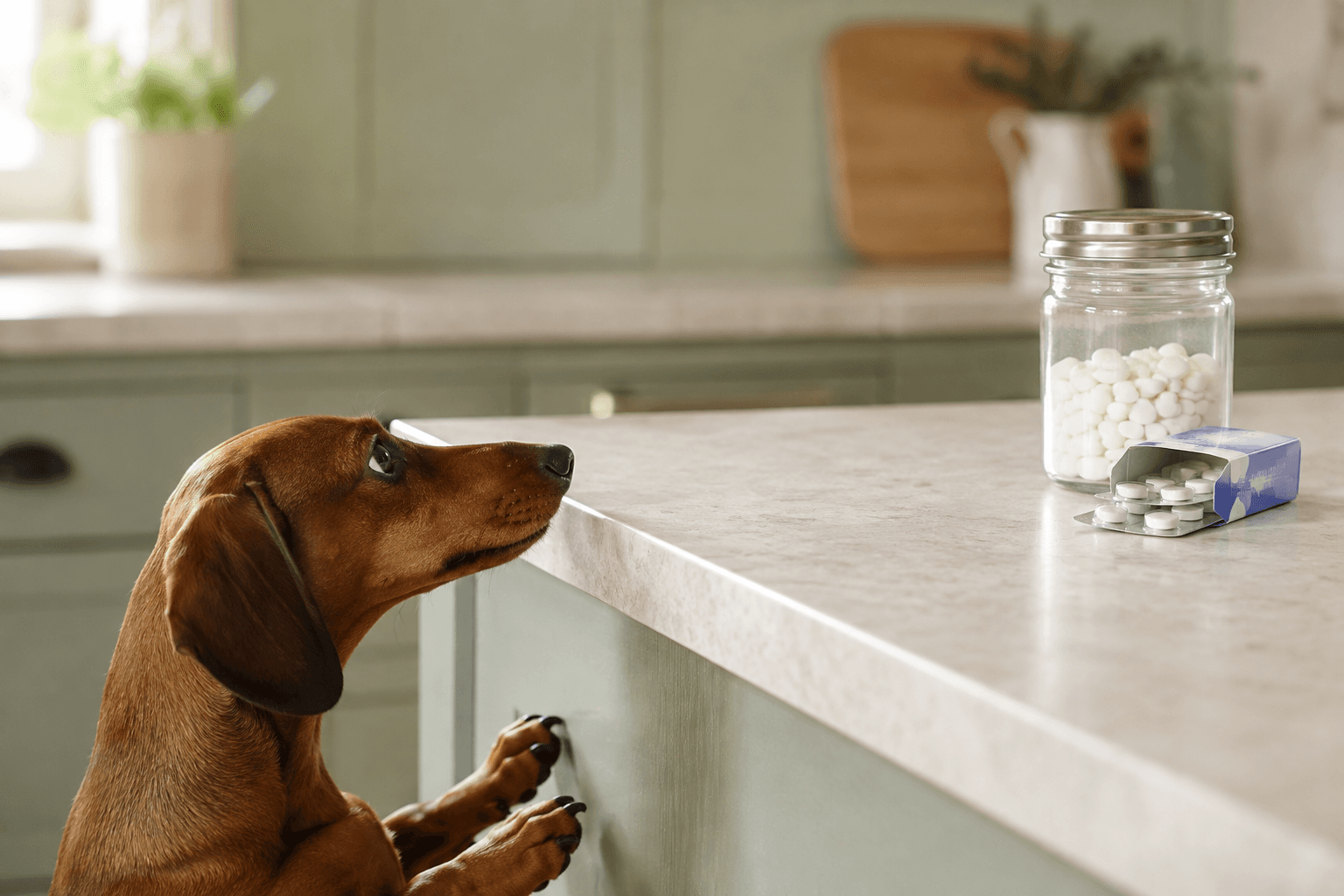
If your dog has eaten xylitol
Ring your vet or the Animal PoisonLine now, even if your dog seems fine. Take the packaging with you so the ingredients can be checked. Do not wait for symptoms to appear, since early treatment is more effective. Out of hours, Vets Now runs emergency clinics across the UK, and the Animal PoisonLine is on 01202 509000.
The detail
Xylitol is a sugar alcohol used to sweeten food without the calories or blood sugar spike ordinary sugar causes in humans, and it does that by prompting the pancreas to release insulin. In a dog, the same mechanism happens far more aggressively than in a person, and the MSD Veterinary Manual states this can cause a profound drop in blood sugar within thirty minutes of eating it.
There are two separate thresholds to know, and the MSD Veterinary Manual is specific about both. Doses above roughly 100mg per kilogram of body weight are linked to hypoglycaemia, while doses above roughly 500mg per kilogram carry a real risk of severe liver damage or failure, a much higher dose but still one a determined dog can reach from a bag of sweets or a tub of nut butter.
The liver injury outcome is the one worth taking seriously. The MSD Veterinary Manual reports that 62.5% of dogs that developed clinical signs of liver injury died or were put to sleep despite aggressive treatment, which is why any suspected xylitol ingestion, large or small, is treated as a genuine emergency rather than something to monitor at home.
Xylitol toxic dose thresholds
| Hypoglycaemia threshold | Around 100mg per kg of body weightMSD Veterinary Manual |
| Liver failure threshold | Around 500mg per kg of body weightMSD Veterinary Manual |
| Onset of hypoglycaemia | 30 minutes, up to 12 to 18 hours depending on the productMSD Veterinary Manual |
| Onset of liver injury | Enzyme changes within 4 to 12 hours; signs by 24 to 48 hoursMSD Veterinary Manual |
| Mortality if liver injury occurs | 62.5% of affected dogs died or were euthanised despite treatmentMSD Veterinary Manual |
Sugar-free chewing gum and mints
Sugar-free gum is the most common source of accidental xylitol poisoning, and VCA Animal Hospitals notes the amount of xylitol in a product varies enough that there is no single safe rule of thumb. A packet of gum left in a coat pocket or a bag is a realistic way for a dog to reach a hypoglycaemic dose, particularly a small dog.
Sugar-free mints carry the same risk in a more concentrated, easier-to-swallow form. Check the ingredients on any sugar-free gum or mint packet in the house, and store it somewhere a dog genuinely cannot reach, rather than somewhere it simply seems uninterested in.
Peanut butter and other nut butters
Most UK peanut butter brands do not use xylitol, but some sugar-free and diet-marketed nut butters do, and peanut butter is a food dogs are specifically drawn to and often given deliberately as a treat, which makes a xylitol-sweetened jar a genuine risk sitting in plain sight in the cupboard.
Check the ingredients list on any peanut butter before using it as a treat or a way to hide a tablet, and keep doing this even for a brand you have used safely before, since some manufacturers have reformulated products to include xylitol without a prominent warning on the front of the jar.
Birch sugar and E967 on UK food labels
Xylitol appears under several different names on UK packaging, and PDSA notes it is sometimes called birch sugar, since it can be extracted from birch bark as well as other plant sources. The Kennel Club adds that it may also be listed under the additive code E967.
Reading past the word xylitol matters, because a product marketed as naturally sweetened with birch sugar sounds harmless and can easily be handed over without a second thought. Get into the habit of checking the full ingredients list on any sugar-free or diet product before a dog gets near it, rather than relying on the front-of-pack claims.
Toothpaste, mouthwash and medicines containing xylitol
Human toothpaste and mouthwash are already on the do-not-share list for dogs, and xylitol is one more reason on top of the fluoride, since it is a common sweetener in these products. The same applies to some chewable vitamins, cough syrups and over-the-counter medicines.
This matters most for dogs that chew through bathroom bags or bins, since a tube of toothpaste or a blister pack of chewable tablets is a realistic target. Keep these stored the way you would any other genuine toxin, in a cupboard rather than a bag on the floor.
My dog ate something with xylitol in it. What should I do?
Ring your vet or the Animal PoisonLine immediately, and take the packaging with you or have it to hand so you can read out the ingredients, since the exact xylitol content changes what your vet advises. Do not wait for symptoms to appear, since treatment given before hypoglycaemia sets in is more straightforward than treatment given after.
Watch for vomiting, weakness, wobbliness or collapse in the first couple of hours, and be aware that a dog can seem fine initially and still develop liver problems a day or two later. VCA Animal Hospitals notes that supportive treatment, including fluids and monitoring, is usually needed for at least a day even in milder cases.
Signs to watch for
- Vomiting shortly after eating
- Weakness, wobbliness or difficulty standing
- Collapse or seizures as blood sugar drops
- Lethargy or yellowing of the gums or eyes, appearing a day or two later if the liver is affected
Common questions
What foods commonly contain xylitol in the UK?
Sugar-free chewing gum and mints are the most common source, alongside some sugar-free nut butters, baked goods, chewable vitamins and toothpaste. PDSA notes it can also be labelled birch sugar, and the Kennel Club notes it may appear under the code E967.
How much xylitol is dangerous for a dog?
The MSD Veterinary Manual puts the hypoglycaemia threshold at around 100mg per kilogram of body weight and the liver failure threshold at around 500mg per kilogram. VCA Animal Hospitals adds that the exact amount varies by product, so there is no single safe number to rely on.
Is birch sugar the same as xylitol?
Yes. PDSA notes xylitol is sometimes labelled as birch sugar, since it can be extracted from birch bark as well as other plant sources. Treat any product listing birch sugar exactly as you would one listing xylitol.
My dog licked a xylitol-sweetened yoghurt. Is that dangerous?
It can be, since even a small lick from a xylitol-sweetened product can add up for a small dog. Ring your vet with the product's ingredients list rather than assuming a lick is too small to matter.
What are the signs of xylitol poisoning?
Early signs include vomiting, weakness, wobbliness and collapse as blood sugar drops, often within thirty minutes to two hours. Liver injury can follow a day or two later, sometimes with lethargy or yellowing of the gums or eyes, even if the early symptoms seemed to pass.
Can dogs recover from xylitol poisoning?
Many do, especially with early treatment for hypoglycaemia, but the outlook is far more serious once liver injury develops. The MSD Veterinary Manual reports that 62.5% of dogs with signs of liver injury died or were euthanised despite aggressive treatment, which is why speed matters.
Can puppies be poisoned by xylitol?
Yes, and more easily than an adult dog, since the same amount of xylitol is a bigger dose relative to a puppy's small body weight. Keep any xylitol-containing product well away from puppies.