
Can dogs eat marshmallows?
Updated 7 August 2026
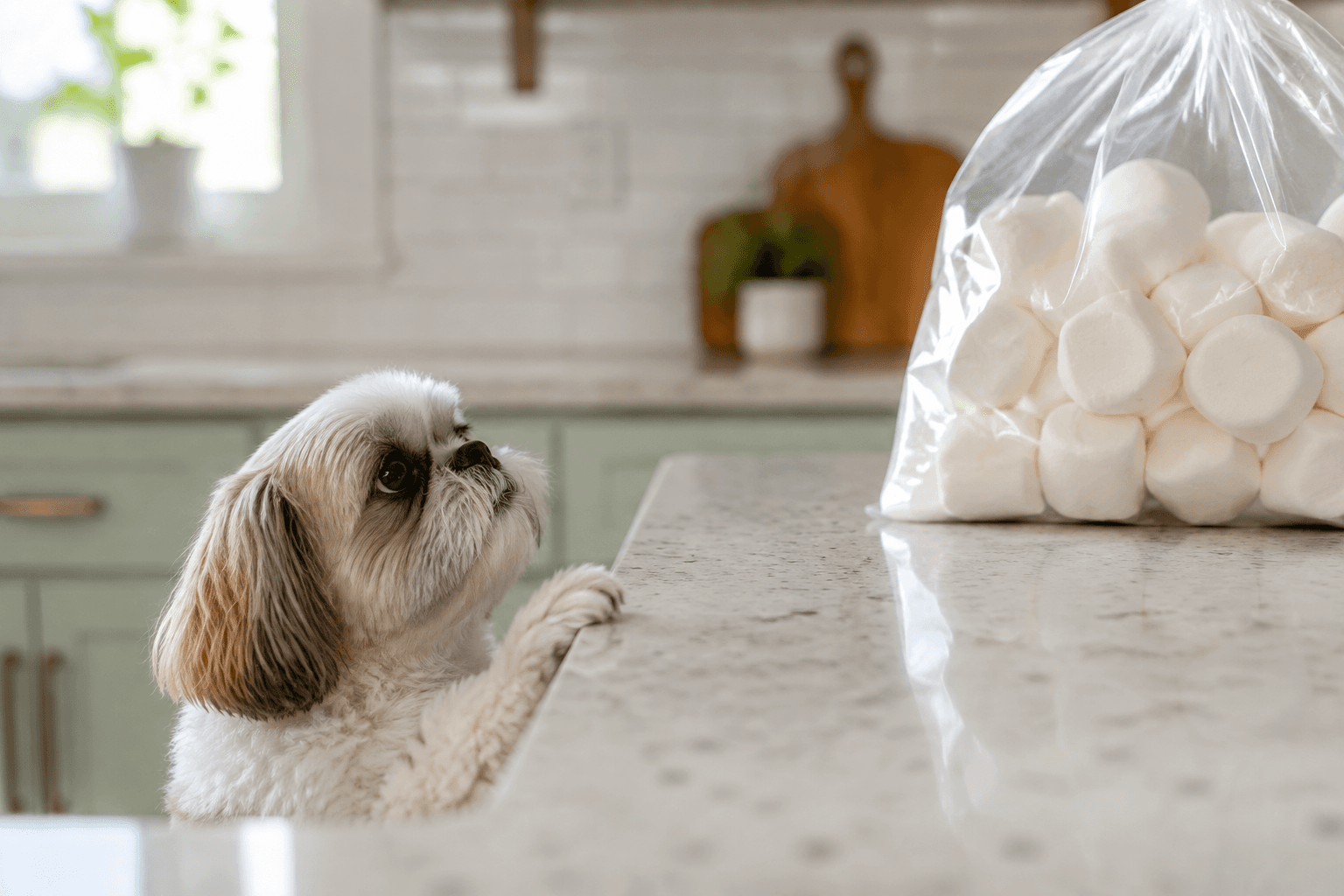
Only with care, and only the ordinary kind. A regular sugar marshmallow is not toxic and one or two will not harm most dogs, but it is pure sugar with nothing else in it, at around 4 to 5g of sugar each. Sugar-free and diet marshmallows are a different matter: some are sweetened with xylitol, which the Pet Poison Helpline links to life-threatening low blood sugar and liver failure.
- The detail
- What is in a marshmallow
- How much is sensible
- Sugar-free and diet marshmallows
- Toasted marshmallows and bonfire night
- Marshmallow fluff, vegan marshmallows and rocky road
- Rice krispie treats and s'mores
- Marshmallows and choking
- Easter marshmallow chicks and eggs
- Better things to share
- Common questions
The detail
A marshmallow is sugar, corn syrup, gelatine and whipped air, with almost nothing else in it. A large roasting marshmallow, around 30g, carries roughly 90 calories and 14g of sugar, and a mini marshmallow from a hot chocolate packet is closer to 6 calories and around 1g of sugar.
Gelatine itself is not a problem; it is a protein used in plenty of dog treats and does not cause the reactions the sugar can. The sugar is the real content of a marshmallow, and it is the reason a whole bag is a stomach upset waiting to happen rather than a treat worth offering. This also explains why traditional marshmallows are not vegetarian: gelatine is typically derived from animal collagen, most often pork or beef, which is why vegan versions exist for owners who prefer to avoid that.
A 10kg dog has a sensible daily treat budget of roughly 40 kcal, so a single large marshmallow at around 90 kcal spends more than double that budget in one bite, even before the xylitol question comes up. Several marshmallows from a packet left within reach add up fast in a small dog.
The genuine hazard is sugar-free and diet marshmallows, which have become common alongside keto and low-sugar baking. Xylitol is one of the sweeteners used to replace the sugar, and the Royal Kennel Club names it among the foods that can crash a healthy dog's blood sugar and, in larger amounts, cause liver failure.
The difference between a safe treat and an emergency comes down to reading the bag. A packet that lists sugar, glucose syrup or corn syrup is the ordinary kind; one that lists xylitol, birch sugar or sugar alcohol anywhere in the ingredients is not one to share, however small the piece.
What is in a marshmallow
| Large marshmallow (about 30g) | About 90 kcal, 14g sugar |
| Mini marshmallow (about 2g) | About 6 kcal, 1g sugar |
| Daily treat budget (10kg dog) | About 40 kcalOne large marshmallow alone uses more than double that |
| Fat and protein | Almost noneA marshmallow is sugar, corn syrup and gelatine |
| Anything toxic to dogs | Nothing in the ordinary kindXylitol in sugar-free versions is a genuine emergency |
How much is sensible
| Dog size | Sensible amount |
|---|---|
| Small (under 10kg)Chihuahua, Jack Russell | One regular marshmallow, rarely, checked for xylitol first |
| Medium (10 to 25kg)Cocker spaniel, border collie | Two regular marshmallows, occasionally |
| Large (over 25kg)Labrador, German shepherd | Three or four regular marshmallows, occasionally |
| Overweight or diabetic dogs | None. A marshmallow is sugar with nothing else to justify it |
Sugar-free and diet marshmallows
This is the version to actively worry about. Xylitol-sweetened marshmallows are sold as keto-friendly or diabetic-friendly treats, and the Pet Poison Helpline says even a small amount can cause a dog's blood sugar to crash within 10 to 15 minutes.
Signs come on fast: vomiting, weakness, wobbliness or collapse. If your dog has eaten anything from a bag marked sugar-free, low-sugar or keto, treat it as an emergency and ring your vet rather than waiting to see if symptoms appear, taking the packet with you so the vet can read the ingredients.
UK supermarket shelves carry both kinds side by side, and a diet or protein-focused marshmallow can look almost identical to the ordinary bag from a distance. Reading the front of the pack is not enough; the ingredients list on the back is the part that actually tells you what sweetens it.
Toasted marshmallows and bonfire night
A marshmallow roasted on a stick brings its own hazards that have nothing to do with the ingredients. Molten sugar holds heat far longer than it looks like it should, and a dog that snatches a marshmallow off a stick, or one dropped near a fire, can burn its mouth badly.
Wooden and metal skewers left within reach are the other risk, since a dog working a marshmallow off a stick can swallow the stick itself. Keep dogs a stick's length back from an open fire, and clear dropped marshmallows and skewers before they cool on the ground rather than leaving them for later.
Marshmallow fluff, vegan marshmallows and rocky road
Marshmallow fluff is the same sugar and corn syrup base in spreadable form, so a lick from a spoon is no different from a piece of the solid version, just harder to portion accurately. Vegan marshmallows swap gelatine for a plant-based setting agent, usually carrageenan or agar, and the sugar content is broadly the same as ordinary marshmallows.
Rocky road and similar bakes combine marshmallow with chocolate, and chocolate is genuinely toxic to dogs, so a slice of rocky road is a chocolate incident that happens to have marshmallow in it. Treat any marshmallow mixed with chocolate as a chocolate question first and a marshmallow question second.
Rice krispie treats and s'mores
A rice krispie treat is melted marshmallow set around puffed rice cereal, which adds very little beyond more sugar and a stickier texture that some dogs choke on if they gulp a piece whole. It is not a toxic combination, just a concentrated one.
S'mores add chocolate and a digestive biscuit to the mix, which brings chocolate's theobromine into the picture. A dog that steals a whole s'more has effectively had a small chocolate dose alongside the sugar, and the amount and type of chocolate eaten are what your vet will want to know first, along with your dog's weight.
Marshmallows and choking
A whole marshmallow, especially a large roasting one, is soft, round and slightly sticky, which is an easy shape for an excited dog to gulp without chewing. That is less of a problem for a Labrador than for a small dog or a flat-faced breed with a narrower throat.
Break large marshmallows into smaller pieces before offering one, the same way you would with any soft, rounded treat, and supervise while your dog eats it rather than leaving a bagful within reach.
Easter marshmallow chicks and eggs
Marshmallow chicks and eggs sold around Easter are often coated in a thin layer of chocolate or dusted with coloured sugar, which changes the risk considerably. A chocolate-coated marshmallow treat is a chocolate incident first, with the same theobromine concern as any other chocolate confectionery.
Easter is also when small chocolate eggs and marshmallow sweets get left within reach in bowls and baskets around the house, so the practical risk often has more to do with where they are stored than with the marshmallow itself. Keep any Easter sweets, chocolate-coated or not, well out of a dog's reach.
Signs to watch for
- Loose stools or an upset stomach after several ordinary marshmallows
- Vomiting, weakness, wobbliness or collapse after anything sugar-free, which is an emergency
- A burnt mouth or drooling after snatching a toasted marshmallow
If your dog overdoes it
For one or two ordinary marshmallows, water and a skipped treat is enough. If your dog has eaten anything marked sugar-free, low-sugar or keto, or is showing weakness, vomiting or collapse, ring your vet immediately and take the packet so they can read the ingredients. Out of hours, Vets Now runs emergency clinics across the UK, and the Animal PoisonLine is on 01202 509000.
Common questions
Are marshmallows poisonous to dogs?
Ordinary sugar marshmallows are not toxic, though they offer nothing but sugar. Sugar-free or diet marshmallows are the genuine danger, since some contain xylitol, which the Pet Poison Helpline links to a rapid and dangerous drop in blood sugar.
How do I know if a marshmallow has xylitol in it?
Check the ingredients list for xylitol, birch sugar or sugar alcohol, most likely on a bag marked sugar-free, keto or diabetic-friendly. Ordinary marshmallows list sugar, glucose syrup or corn syrup instead.
My dog ate a sugar-free marshmallow, what do I do?
Ring your vet or an emergency vet immediately and take the packet with you. Symptoms of xylitol poisoning can start within 10 to 15 minutes, so this is not a wait-and-see situation.
Can dogs eat marshmallow fluff?
In a small lick it carries the same risk profile as a solid marshmallow: fine occasionally if it is the ordinary sugar kind, and a concern if it is a sugar-free spread containing xylitol. Check the label either way.
Can dogs have s'mores?
Better not to share them. A s'more combines marshmallow with chocolate and a biscuit, and chocolate is toxic to dogs regardless of what else is in the stack.
Are vegan marshmallows safe for dogs?
The gelatine-free setting agents used in vegan marshmallows, usually carrageenan or agar, are not a particular danger. The sugar content is much the same as ordinary marshmallows, so the same small-amount rule applies, and sugar-free vegan versions still need a xylitol check.