
Can dogs eat sunflower seeds?
Updated 8 August 2026
With caution, yes: shelled, plain, unsalted sunflower seed kernels are fine in small amounts, but the shell is the real hazard, not the seed. Nutritionvalue.org puts an ounce of shelled kernels at around 14g of fat and next to no sodium, while the woody outer shell is not properly digestible and is a genuine choking and blockage risk if a dog eats a handful whole.
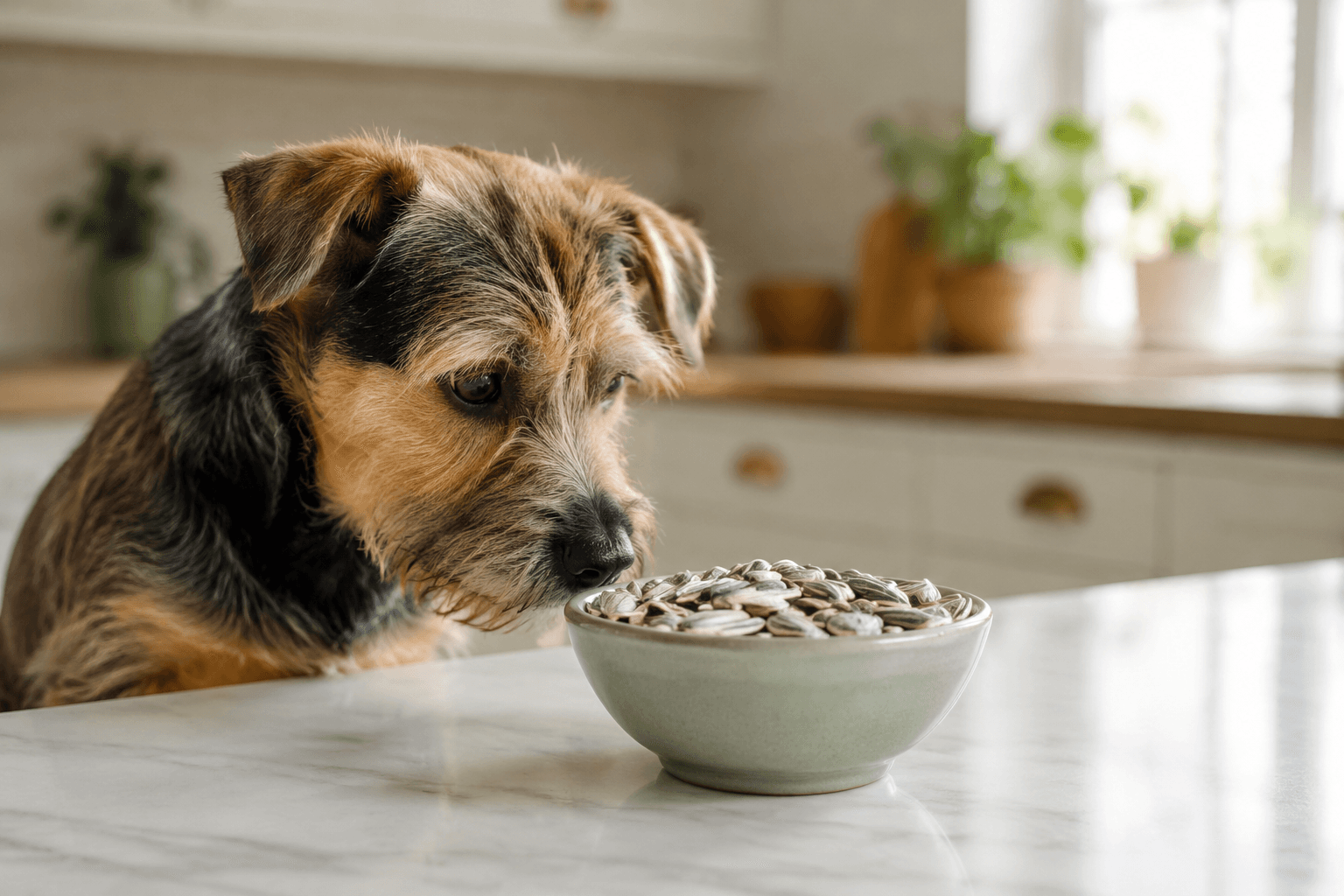
- The detail
- Shelled vs shell-on sunflower seeds
- How much is sensible
- Shelled or in the shell, does it matter?
- Are salted sunflower seeds, the snacking kind, safe for dogs?
- My dog ate a handful of shell-on sunflower seeds, what now
- Are sunflower seeds in dog food different from snacking seeds?
- Bird feeder seed on the ground, a hazard worth knowing about
- Better things to share
- Common questions
The detail
The kernel inside a sunflower seed is not toxic to dogs, and a small amount of the shelled, plain version is a reasonably low-risk snack. Nutritionvalue.org's figures for dried sunflower kernels put an ounce at around 165 calories and 14g of fat, most of it unsaturated, so the practical limit is portion size rather than any toxin.
The shell is a different matter entirely. It is fibrous and woody, built to protect the seed rather than to be eaten, and VCA Animal Hospitals' guidance on foreign body ingestion in dogs lists vomiting, lethargy, abdominal pain and straining among the signs of an obstruction when something a dog eats will not pass through the gut. A dog that works through a handful of shell-on seeds, rather than spitting the husks out the way a person does, is the scenario that risk applies to.
Salt is the other everyday risk, since sunflower seeds sold for human snacking are very often roasted and salted, sometimes heavily. Pet Poison Helpline's guidance on salt lists vomiting, diarrhoea, tremors and, in severe cases, seizures among the signs of salt poisoning, and a whole bag of salted, shell-on seeds combines both risks in one packet.
Sunflower seeds also turn up somewhere less obvious than the snack aisle: bird feeders and the spilled seed underneath them. A dog that spends time in a garden with a feeder overhead has repeated, low-level access to shell-on seeds on the ground, which is worth knowing about even if a single seed here and there is not a real concern.
Shelled vs shell-on sunflower seeds
| Shelled kernel, plain, unsalted | Low risk in small amountsApprox. 14g fat per ounce, Nutritionvalue.org |
| Shell (husk) | Not digestibleVCA Animal Hospitals: indigestible material can cause a gut obstruction |
| Roasted and salted (snacking bags) | Higher riskPet Poison Helpline: salt can cause vomiting, tremors, seizures |
| Sodium, unsalted kernels | Well under 1mg per ounceSalted versions carry considerably more |
How much is sensible
| Dog size | Sensible amount |
|---|---|
| Small (under 10kg)Chihuahua, Jack Russell | A few plain, shelled sunflower kernels, unsalted, once in a while |
| Medium (10 to 25kg)Cocker spaniel, border collie | A teaspoon of plain, shelled sunflower kernels occasionally |
| Large (over 25kg)Labrador, German shepherd | A tablespoon of plain, shelled sunflower kernels now and then |
Shelled or in the shell, does it matter?
Yes, this is the single most important distinction with sunflower seeds. The kernel is soft, digestible and reasonably low risk in a small amount, while the shell is hard, fibrous and not something a dog's gut can break down.
People eating sunflower seeds from the shell spit the husk out; a dog eating from the same bag generally does not, and swallows shell and kernel together. That is what turns an occasional snack into a genuine choking and blockage risk.
Are salted sunflower seeds, the snacking kind, safe for dogs?
Not something to offer on purpose. The bagged sunflower seeds sold for human snacking are usually roasted and salted, and often still in the shell, combining the two main risks on this page in one product.
Pet Poison Helpline's guidance on salt describes vomiting, tremors and, in severe cases, seizures as signs of salt poisoning, and a dog getting into a family-size bag at once is a bigger concern than the odd unsalted kernel dropped on the floor.
My dog ate a handful of shell-on sunflower seeds, what now
Watch closely for vomiting, gagging, lethargy, straining to defecate or a reluctance to eat over the following day or two, the signs VCA Animal Hospitals lists for an intestinal obstruction. A handful is more concerning than one or two stray seeds, since it is the volume of indigestible shell that raises the blockage risk.
Call your vet if you see any of those signs, or if your dog is a small breed that swallowed a genuinely large amount. PDSA's first aid guidance on choking is the immediate reference if your dog seems to be struggling to breathe rather than just having swallowed the seeds.
Are sunflower seeds in dog food different from snacking seeds?
Yes. Sunflower oil, and less commonly ground sunflower seed meal, appears in some commercial dog foods as a source of vitamin E and fatty acids, in carefully controlled, processed amounts rather than whole seeds with shells attached.
That is a different situation entirely from a dog raiding a bag of snacking seeds or a spilled bird feeder, and it is not a reason to think whole seeds are fine to add at home in the same way.
Bird feeder seed on the ground, a hazard worth knowing about
Sunflower hearts and shell-on mixes are common in UK garden bird feeders, and the seed that misses the feeder and lands on the lawn is exactly the kind of low-level, repeated access that is easy to overlook. A dog that regularly hoovers up spilled seed under a feeder is getting small but frequent doses of shell along with the kernel.
This is unlikely to cause a dramatic problem from a few seeds at a time, but it is worth clearing spilled seed if your dog has access to the garden underneath a feeder, particularly for a small dog.
Signs to watch for
- Vomiting or gagging after eating shell-on seeds
- Straining to defecate or passing very little
- Lethargy or a reluctance to eat
- Excessive thirst after a salted, roasted batch
Common questions
Can dogs eat sunflower seeds?
Yes, in small amounts, as long as they are shelled, plain and unsalted. The shell itself is the main risk, not the kernel.
Are sunflower seed shells dangerous for dogs?
Yes. VCA Animal Hospitals' guidance on foreign body ingestion notes that indigestible material can cause a gut obstruction, and a shell-on seed is exactly that kind of material in enough quantity.
Are salted sunflower seeds safe for dogs?
Not something to offer deliberately. Pet Poison Helpline lists vomiting, tremors and seizures among the signs of salt poisoning, and salted snacking seeds are often shell-on too.
My dog ate a handful of sunflower seeds, should I worry?
Watch for vomiting, straining or a reluctance to eat over the next day or two, and call your vet if any appear. A handful of shell-on seeds is more concerning than a few loose kernels.
Is sunflower oil in dog food the same risk as whole seeds?
No. Sunflower oil used in commercial dog food is a processed, controlled ingredient, a different situation from a dog eating whole, shell-on seeds from a bag or the garden.
Why do bird feeders matter for sunflower seeds and dogs?
Spilled bird seed under a feeder often includes shell-on sunflower seeds, giving a dog repeated low-level access in the garden. It is worth clearing regularly if your dog spends time underneath one.
How many sunflower seeds can a dog have?
A few plain, shelled kernels for a small dog, up to a tablespoon for a large one, is a reasonable occasional amount. More than that, or any shell-on seeds, is not worth the risk.