Can dogs eat corn on the cob?
Updated 8 August 2026
No, the cob itself is unsafe. The kernels are fine for dogs in small amounts, but a corn cob does not break down in a dog's gut, and vets treat swallowed cobs as a genuine blockage emergency that often ends in surgery. Keep whole cobs, cooked or raw, away from dogs entirely.
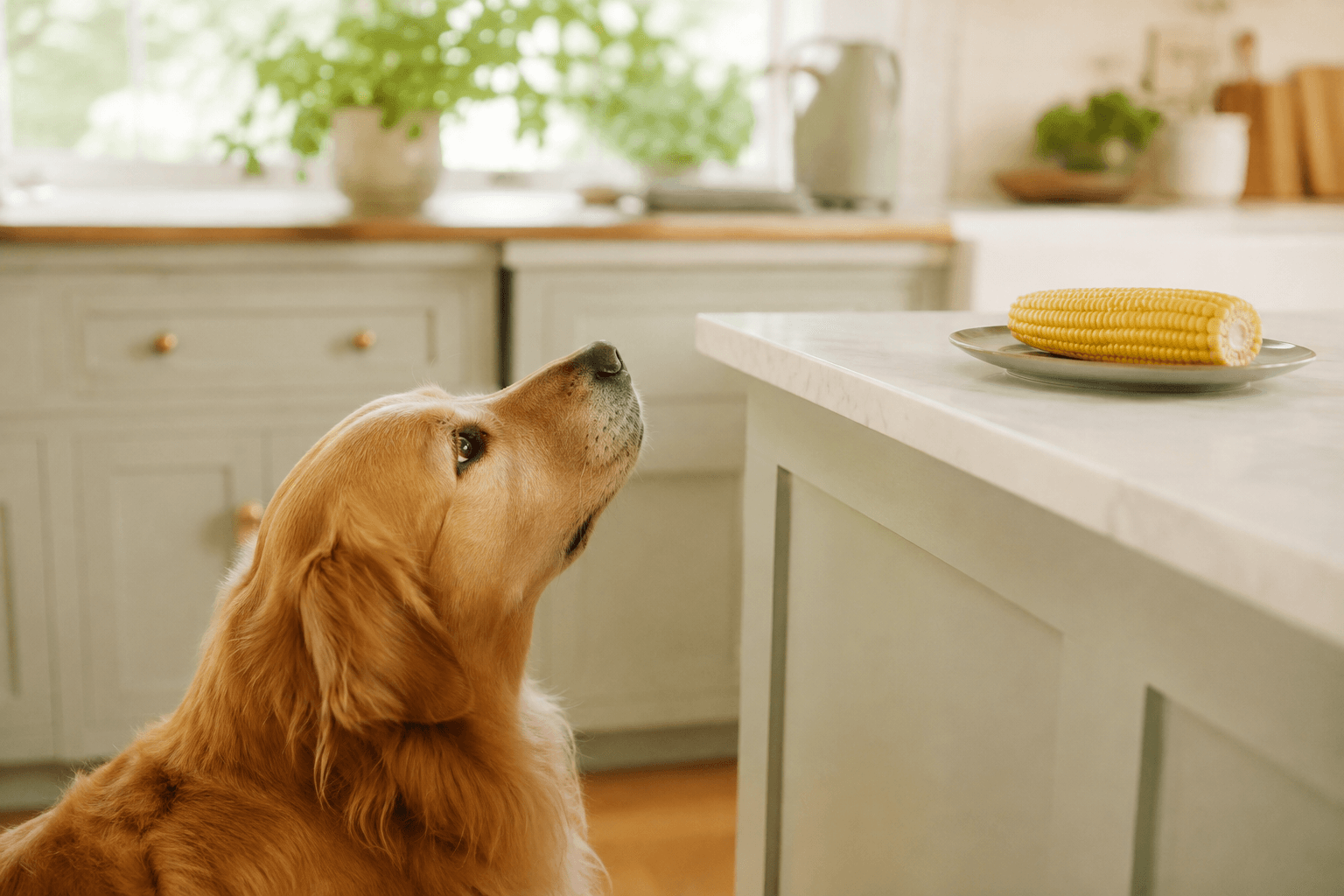
If your dog has eaten corn on the cob
Call your vet immediately if you know or suspect your dog has swallowed a corn cob, even if they seem completely normal. Do not try to make them vomit, since a rigid cob can cause more damage on the way back up. Do not offer food or water until your vet has advised you, and be ready to describe the size of the cob and roughly how long ago it happened.
The detail
The confusion here is understandable, because sweetcorn itself is not the problem. Vets Now's advice on dogs and corn cobs is explicit that plain sweetcorn kernels, removed from the cob, contain protein, antioxidants and fatty acids and are a reasonable treat in small amounts. It is the woody core the kernels grow on that causes the trouble.
A cob does not soften or dissolve anywhere in a dog's digestive tract. Once swallowed, whole or in a large chunk, it can lodge in the stomach or small intestine, and the British Veterinary Association has said plainly that corn itself is not poisonous to dogs, but a cob can cause an obstruction with serious digestive consequences. In a 2024 BVA survey, 56% of companion animal vets said they had treated a pet for eating a corn cob.
The danger is that a blocked dog does not always look like an emergency at first. Vets Now notes that dogs who swallow a cob are often initially unaware anything is wrong, and clear signs such as vomiting, going off food, lethargy or straining to pass stools can take hours or even until the next day to show. Dogs seen by a vet before the cob moves further into the intestine generally have the best chance of a straightforward recovery.
Barbecues and picnics are the classic danger point in the UK, since a discarded cob left on a plate or in a bin is exactly the kind of thing a food-motivated dog will grab. Bagging cobs up and putting them in a lidded bin straight after eating, rather than leaving them on the side, removes most of the risk.
Are corn kernels safe if the cob is removed
Yes. Once the kernels are off the cob, plain cooked or raw sweetcorn is a reasonably low-risk treat for most dogs, and Vets Now names it as a source of protein, antioxidants and essential fatty acids. A spoonful mixed into a meal, with no butter or salt, is the sensible way to share it.
The kernels are not entirely risk-free either. Sweetcorn has a tough outer hull that some dogs do not chew properly, so it can pass through undigested, and a large bowlful at once can upset a sensitive stomach. Small amounts, plain, are the safer version.
My dog ate a corn cob, what do I do now
Ring your vet straight away rather than waiting to see how things go. Vets Now is clear that this is treated as a foreign body case, and a dog examined before the cob has moved deep into the intestine generally has a better outcome than one left until it is already causing pain.
Do not try to make your dog sick at home. A cob is rigid and can cause more damage coming back up through the throat than it did going down, and vets have better, safer tools for checking exactly where it has got to, including x-rays and ultrasound.
Signs of a corn cob blockage in dogs
Watch for vomiting, a reduced appetite, lethargy, straining or an inability to pass stools, and a painful or tense abdomen. The British Veterinary Association's guidance groups these under the general symptoms of a gut obstruction from any swallowed object, corn cobs included.
These signs do not always appear the same day. Vets Now notes dogs can seem fine at first and only show problems later that day or the next, which is exactly why a known cob swallow is worth a same-day vet call even before symptoms start.
Can a small dog cough up or pass a corn cob on its own
Occasionally a small fragment passes through without incident, but this is not something to bank on. A cob is roughly cylindrical and rigid, and the size of the dog matters far less than the size of the piece swallowed relative to their gut.
Vets Now's guidance treats every known cob ingestion as needing a veterinary check, regardless of the dog's size, because there is no reliable way to tell from the outside whether it will pass or lodge.
Corn cob surgery cost and recovery for dogs
Removing a lodged cob usually means anaesthesia and often surgery, since the British Veterinary Association's reporting on this issue describes vets carrying out physical exams, blood tests, x-rays, ultrasound and, frequently, an operation to retrieve the object.
Recovery after surgery to remove a gut obstruction typically involves several days of monitoring, a bland diet as the gut heals, and a course of pain relief, which is part of why prevention, keeping cobs in a lidded bin, matters so much at a barbecue or picnic.
Signs to watch for
- Vomiting or repeated retching
- Going off food or refusing meals
- Lethargy or reluctance to move
- Straining to pass stools, or no stools at all
- A tense, painful or bloated-looking abdomen
Common questions
Is sweetcorn itself bad for dogs?
No. Plain sweetcorn kernels, off the cob, are a low-risk treat that Vets Now names as a source of protein and fatty acids. The danger is entirely the woody cob, not the kernels.
My dog ate a small piece of corn cob, not the whole thing. Is that still an emergency?
Yes, call your vet the same day regardless of the size of the piece. Vets Now treats any known cob ingestion as needing a check, since even a fragment can lodge in the intestine.
How long does it take for a corn cob to cause symptoms in a dog?
It varies, and Vets Now notes dogs are often initially unaware anything is wrong, with clear symptoms sometimes not appearing until later that day or the next. Do not wait for symptoms before calling your vet if you know a cob was swallowed.
Can a corn cob pass through a large dog without a problem?
It is possible but not something to rely on. Vets Now's guidance treats a swallowed cob as needing veterinary assessment in dogs of any size, since there is no reliable way to predict from outside whether it will pass safely.
Does a corn cob blockage always need surgery?
Not always, but often. The BVA's reporting describes vets using x-rays and ultrasound to locate the cob, with surgery frequently needed to remove it once it has lodged rather than passed naturally.
Are baby corn or tinned sweetcorn safer than corn on the cob?
Yes, because neither has a hard central cob for a dog to swallow. Plain tinned sweetcorn, drained and unsalted, or a piece of baby corn, carries the same low general risk as loose kernels, not the blockage risk of a full cob.
Should I induce vomiting if my dog just ate a corn cob?
No, do not try to make your dog vomit at home. A rigid cob can cause further damage coming back up, and your vet has safer ways to assess and remove it, including x-rays and, if needed, surgery.