
Can dogs eat chicken bones?
Updated 7 August 2026
No. Cooked chicken bones are unsafe for dogs. Cooking makes bone brittle, and the Kennel Club says eating chicken, turkey or goose carcasses can cause pieces to obstruct the gut or splinters to penetrate the stomach or intestinal wall. Raw chicken bones are a separate, less clear-cut question, and still need a vet's input before you offer one.
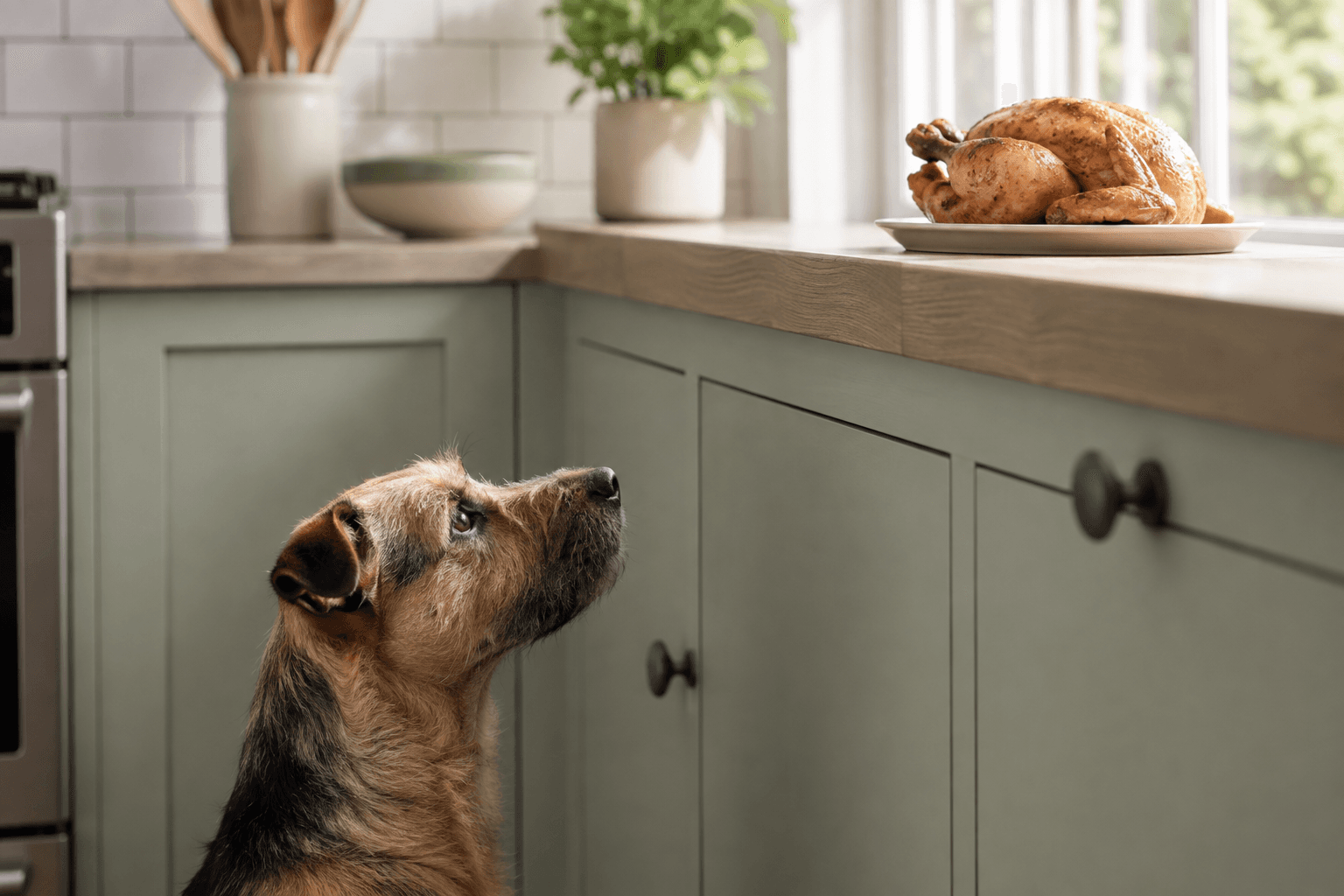
If your dog has eaten chicken bones
Ring your vet straight away, even if your dog seems fine, and tell them roughly how much bone and what kind, cooked or raw. Do not try to make your dog vomit unless a vet tells you to, since sharp fragments can cause more damage coming back up than staying down. Keep any leftover bones so the vet can see what your dog swallowed, and watch closely for gagging, vomiting, reduced appetite, straining or abdominal pain over the next 48 to 72 hours. Out of hours, Vets Now runs emergency clinics across the UK if your usual vet is closed.
The detail
Cooking changes a bone from something a dog's stomach acid can slowly work through into something that shatters. The RSPCA's advice on dog dental care says cooked bones are likely to fragment and cause internal damage, while raw bones carry their own risks of dental fractures and constipation even though they don't splinter the same way.
VCA Animal Hospitals lists the ways a shattered bone causes harm: broken teeth, punctured tongues and cheeks, bones lodged around the jaw, choking on a fragment stuck in the throat, and sharp pieces perforating the stomach or gut wall, which can lead to peritonitis, a bacterial abdominal infection VCA says can be fatal even if treated aggressively. The Kennel Club is specific about poultry: eating chicken, turkey or goose carcasses can send larger pieces into an obstruction, while smaller splinters irritate the gut or penetrate the stomach or intestinal wall.
A dog that has eaten bones before without a problem has been lucky, not proven safe. PDSA sees dogs with gut damage and blockages from swallowed bones regularly enough to advise never feeding them as treats at all, and the outcome depends on the individual piece, not the dog's track record.
Size of dog changes the odds rather than removing the risk. A small bone fragment that a Labrador might pass without trouble can be a genuine blockage in a terrier or a toy breed, because the same splinter is much larger relative to a smaller gut.
Chicken bones by type and risk
| Cooked bones (roast, takeaway, rotisserie) | UnsafeRSPCA: cooked bones are likely to fragment and cause internal damage |
| Raw chicken bones | Not automatically safeRSPCA: can still cause dental fractures and constipation; ask your vet first |
| Whole carcass (chicken, turkey, goose) | High risk of obstructionThe Kennel Club names poultry carcasses specifically |
| Bone broth or stock, strained clear of bone | Low risk from the bones themselvesCheck for onion, garlic and added salt instead |
My dog ate a chicken bone, what now?
Ring your vet straight away, even if your dog seems completely normal. Tell them roughly how much bone was eaten, whether it was cooked or raw, and how long ago it happened, since that shapes whether they want to see your dog now or have you watch at home.
Do not try to make your dog vomit unless a vet tells you to. Sharp fragments can cause as much damage coming back up as they did going down, so this is one situation where waiting for professional advice matters more than acting fast at home.
Vets Now advises keeping any leftover bones so the vet can see what your dog swallowed, and watching closely over the following days for loss of appetite, vomiting, a lack of faeces or diarrhoea, dehydration, and reluctance to move or crying out, which point at abdominal discomfort.
Raw chicken bones vs cooked chicken bones
Cooking is what makes bone genuinely dangerous. The RSPCA says cooked bones are likely to fragment and cause internal damage, because the cooking process leaves them brittle enough to shatter into sharp pieces when a dog chews them.
Raw bones are not automatically safe, though some raw feeders offer them. The RSPCA notes that raw, meaty bones can still cause dental fractures in dogs who chew energetically, and constipation, so it recommends asking your vet for advice before giving any bone and supervising your dog while they have it.
Chicken carcass after a roast dinner
A whole roast chicken carcass, or the bones left from turkey or goose at Christmas, is exactly what the Kennel Club warns about by name. It says eating chicken, turkey or goose carcasses can cause larger pieces of bone to obstruct the gut, while smaller splinters can irritate it or penetrate the stomach or intestinal wall, sometimes needing surgery to fix.
Bin the carcass somewhere a dog cannot reach it, not in an open kitchen bin a determined dog can tip over. This applies whether the leftovers are from a Sunday roast, a rotisserie bird, or the Christmas turkey, and a bird left to cool on the side is a common way this happens.
A carcass is also more bone than a dog usually encounters in one go, which makes portion size part of the danger. A dog that manages a single small bone without trouble is not guaranteed to manage a whole ribcage's worth swiped from a cooling tray.
KFC, rotisserie and takeaway chicken bones
A takeaway or supermarket rotisserie chicken carries exactly the same bone risk as a home-cooked one. Cooked bone behaves the same way regardless of where the chicken came from, and fried coatings add salt and fat on top of the bone risk.
If your dog has raided a bin or a takeaway box, try to work out roughly how many bones were in it and call your vet with that estimate. Treat this the same as any other cooked bone incident, because the source of the chicken makes no difference to how the bones splinter.
Small bones such as wing tips and drumettes are easy for a dog to swallow whole rather than crunch up, which some owners assume makes them safer than a larger carcass bone. It does not: a whole wing bone lodged in the throat or gut is just as much an emergency as a splinter from a bigger piece.
Is chicken bone broth or stock safe?
Plain broth made by simmering bones for hours and then straining it clear is a different question from eating bone fragments, because the bone itself is removed before serving. Make sure the recipe has no onion, garlic or added salt, and let it cool before offering a small amount.
Check carefully for softened bone fragments that may have broken off during a long, slow cook and slipped through a coarse strainer. A slow cooker can leave small bone pieces soft enough to miss on a quick check, so strain broth through a fine sieve rather than a colander before giving it to a dog.
A small amount of well-strained broth poured over a dog's usual food is a reasonable treat, particularly for a dog that needs encouragement to drink. It is a topping, not a meal, and does not replace a complete diet.
Signs to watch for
- Gagging, drooling or pawing at the mouth in the first few hours
- Vomiting, reduced appetite or straining to pass a stool over the following days
- A painful, tense abdomen, or crying out when the belly is touched
- No faeces, or diarrhoea, along with dehydration
Common questions
My dog ate a chicken bone, what should I do?
Ring your vet straight away and tell them roughly how much bone and what kind, even if your dog seems fine. Do not try to make your dog vomit, because sharp fragments can cause more damage coming back up. Watch closely for gagging, vomiting, reduced appetite or straining over the next 48 to 72 hours.
Are raw chicken bones safer than cooked ones?
They carry a different risk rather than no risk. The RSPCA says raw bones can still cause dental fractures and constipation, even though they do not splinter the way cooked bones do, so check with your vet before offering any bone.
My dog ate the bones from a Sunday roast chicken carcass. Is that serious?
Yes, treat it as a same-day vet call. The Kennel Club specifically names chicken, turkey and goose carcasses as a cause of obstruction from larger pieces or gut perforation from splinters.
My dog got into a takeaway box with chicken bones in it. What now?
Call your vet with an estimate of how many bones and how long ago. Cooked bones from any source behave the same way once swallowed, brittle and prone to splintering, regardless of where the chicken came from.
Is chicken bone broth or stock safe for dogs?
Plain broth made without onion or garlic and strained clear of bone fragments is generally fine in small amounts. Check it carefully for soft, boiled-down bone pieces before giving it, and be extra careful with anything a slow cooker has reduced the bones almost to nothing in.
What are the signs my dog has a blockage from a bone?
PDSA lists vomiting, abdominal pain, constipation, low energy and loss of appetite as signs of a gut blockage. Any of these after a dog has eaten bones is a reason to contact your vet immediately rather than wait and see.
Can a small dog handle chicken bones better than a large dog?
No, if anything a small dog is more at risk, because the same splinter is larger relative to a smaller throat and gut. Size does not make cooked bone safe for any dog.