
Can dogs eat rhubarb?
Updated 7 August 2026
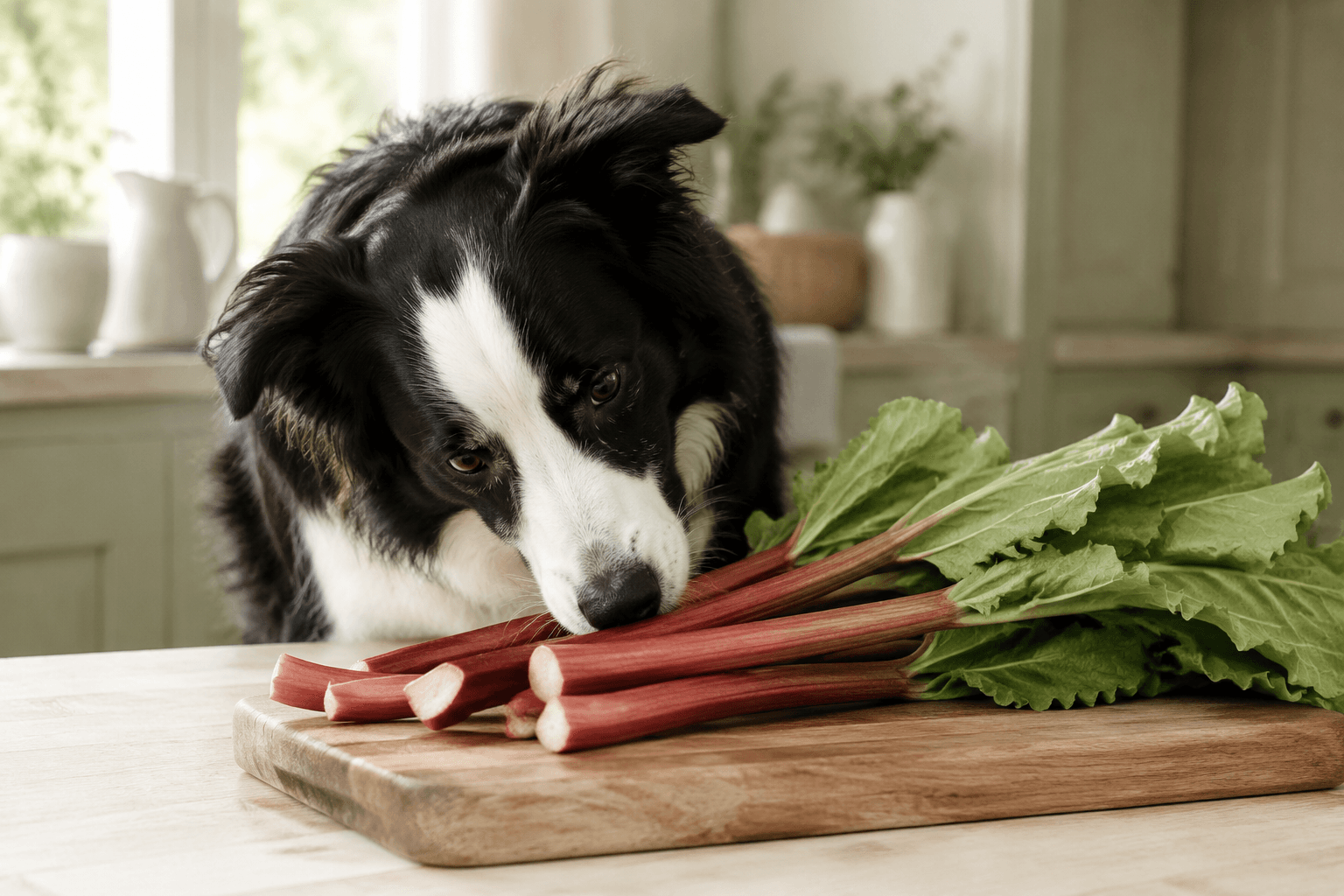
Best avoided, though the danger depends entirely on which part of the plant. The Pet Poison Helpline says rhubarb leaves contain dangerous concentrations of soluble oxalate, while the stalks used in jam and crumble contain very little and are nontoxic. PDSA is blunt about the leaves: they are poisonous to dogs, cooked or raw, so a garden or allotment plant is the bigger everyday risk than a slice of pudding.
- The detail
- Oxalate risk by part of the plant
- How much is sensible
- Rhubarb leaves vs stalks
- Rhubarb crumble, stewed rhubarb and sugar
- Rhubarb plants in the garden or on an allotment
- My dog ate rhubarb leaves. What should I do?
- Rhubarb compared with other oxalate-rich foods
- Better things to share
- Common questions
The detail
Rhubarb is a large-leaved plant grown for its long, pink-red stalks, which are cooked with sugar since they are too sharp to eat raw. Almost every part of the plant contains soluble calcium oxalate, a naturally occurring compound, but the concentration is very different depending on which part a dog gets hold of.
The Pet Poison Helpline states plainly that the leaves and greens carry dangerous concentrations of soluble oxalate, while the stalks used to make rhubarb jams and pies contain very little and are described as nontoxic. That is the whole shape of this page: the pudding on the table is a much smaller worry than the plant in the garden.
Oxalate is the mechanism behind the risk in the leaves. Once absorbed, it binds to calcium in the bloodstream, and the ASPCA lists the resulting clinical signs as kidney failure, tremors and salivation, which is a serious enough list that leaves need treating as an emergency rather than a stomach upset.
This puts rhubarb in a different category from a straightforwardly toxic food like grapes or chocolate. The part most households actually cook with is the low-risk part, but the part growing in a garden bed, an allotment or a container is not, and a dog cannot tell the difference on its own.
Oxalate risk by part of the plant
| Leaves and greens | Dangerous. Contain concentrated soluble oxalatePDSA: poisonous whether cooked or raw |
| Stalks (raw or cooked plain) | Low risk in a small amountPet Poison Helpline describes stalks as containing very little soluble oxalate and nontoxic |
| Crumble or stewed rhubarb with sugar | Best avoidedThe sugar, butter and pastry are the bigger problem, not the fruit itself |
| Clinical signs if leaves are eaten | Kidney failure, tremors, salivationASPCA's listed signs of rhubarb poisoning |
How much is sensible
| Dog size | Sensible amount |
|---|---|
| Small (under 10kg)Chihuahua, Jack Russell | Best avoided; if given, a teaspoon of plain cooked stalk, no sugar, rarely |
| Medium (10 to 25kg)Cocker spaniel, border collie | Best avoided; if given, one to two teaspoons of plain cooked stalk, no sugar, rarely |
| Large (over 25kg)Labrador, German shepherd | Best avoided; if given, a small chunk of plain cooked stalk, no sugar, rarely |
| Dogs with a history of kidney issues, or bladder stones | None, in any form. Oxalate is exactly what a kidney-friendly diet is built to avoid |
Rhubarb leaves vs stalks
This is the single most important distinction on the whole page. The Pet Poison Helpline draws a clear line between the leaves and greens, which carry dangerous concentrations of soluble oxalate, and the stalks, which it describes as containing very little and being nontoxic.
PDSA's plant guidance goes further on the leaves specifically, stating that they are poisonous to dogs and cats whether cooked or raw, so boiling a leaf down does not make it safer. If you grow rhubarb, the leaves should go straight into a food waste bin your dog cannot reach, not the compost heap.
Rhubarb crumble, stewed rhubarb and sugar
A traditional rhubarb crumble or stewed rhubarb is made from the stalk, the part the Pet Poison Helpline calls nontoxic, but it is also cooked with a large amount of sugar and, in a crumble, butter and flour on top. That combination is a poor choice for a dog for reasons that have nothing to do with oxalate.
A small lick of the fruit itself, with none of the sugar or crumble topping, carries a low oxalate risk according to the sources above. A bowlful of pudding is a different matter, and the sugar and fat are the bigger concern in that scenario, the same as with any other sweet dessert.
Rhubarb and custard is a classic British pairing for a reason, and the custard is worth a second thought too. A plain, small amount of custard is a mild everyday treat, but the sugar in a shop-bought custard stacks directly on top of the sugar already in the stewed fruit, so a serving meant for two people is a lot for one dog.
Rhubarb plants in the garden or on an allotment
Rhubarb is a common sight in British gardens and allotments, often grown in a corner bed for years without much thought, which is exactly the setting where a dog is most likely to reach the leaves rather than the cooked stalk. PDSA lists rhubarb among the plants to watch for in spring and summer gardens.
If you grow rhubarb, fence off the bed or plant it somewhere your dog cannot reach unsupervised, the same precaution PDSA recommends for other toxic garden plants such as the allium family or foxglove.
Cutting back rhubarb leaves after harvesting the stalks is a normal part of looking after the plant, and those cut leaves are exactly as poisonous as ones still attached. Bag them for the food waste or council green bin rather than leaving a pile on the compost heap where a dog can dig them out.
My dog ate rhubarb leaves. What should I do?
Ring your vet straight away rather than waiting for symptoms, and try to estimate how much leaf was eaten. The ASPCA lists kidney failure, tremors and salivation among the clinical signs, and none of those are something to manage at home.
Bring a photo or a sample of the plant if you have one, since it helps confirm exactly what your dog got into. Your vet may decide to induce vomiting, give supportive fluids, or simply monitor, depending on the amount and how soon you caught it.
Keep your dog away from water and food until your vet has given advice, since some treatment decisions depend on an empty stomach. Write down the time you found the chewed leaves, even an estimate, as it helps your vet judge how far along any absorption is likely to be.
Rhubarb compared with other oxalate-rich foods
Rhubarb leaves are not the only source of soluble oxalate dogs can encounter. Spinach also carries oxalate, though at a much lower level than rhubarb leaves, which is why this site treats a cooked, plain portion of spinach very differently from any part of the rhubarb plant.
The pattern worth remembering is that oxalate content varies hugely between plants and even between parts of the same plant, so a food being fine in one form does not mean every part of it is safe. A dog with a history of bladder stones or kidney disease is the exception to treat more carefully across the board, since oxalate-rich foods of any kind are usually the ones a vet will ask you to limit.
This is also why this page treats rhubarb differently from a simple green or red traffic light. A dog that has stolen a small piece of plain cooked stalk is a different, much lower-stakes event than a dog that has been seen chewing on the leaves in the garden, and it is worth keeping that distinction in mind rather than treating every mention of rhubarb as equally urgent.
Signs to watch for
- Vomiting or drooling shortly after eating rhubarb leaves
- Weakness or trembling
- Increased thirst or urination, which can point to kidney involvement
- Lethargy or reluctance to move over the following day
Common questions
Can dogs eat rhubarb?
The stalks, plain and without sugar, carry a low risk according to the Pet Poison Helpline, but the leaves are genuinely toxic. Most owners are better off skipping rhubarb altogether rather than sorting one part from the other.
Are rhubarb leaves poisonous to dogs?
Yes. PDSA states that rhubarb leaves are poisonous to dogs and cats whether they are cooked or raw, and the ASPCA lists kidney failure, tremors and salivation among the clinical signs of rhubarb poisoning.
Can dogs eat rhubarb crumble?
No, this is best avoided, but mainly because of the sugar and pastry rather than the rhubarb itself. A crumble is a sweet, fatty dessert on top of a fruit that already carries a small oxalate risk, which is not a combination worth sharing.
My dog ate rhubarb leaves. What should I do?
Ring your vet straight away and try to estimate how much was eaten. Do not wait for symptoms to appear, since the ASPCA lists kidney failure among the possible effects.
Is rhubarb from a garden more dangerous than cooked rhubarb?
It can be, because a growing plant gives a dog access to the leaves as well as the stalks. Fencing off a rhubarb bed is a more useful precaution than worrying about a spoonful of stewed fruit from the kitchen.
Is rhubarb toxic to other pets too?
The ASPCA lists rhubarb as toxic to dogs, cats and horses, with the same oxalate risk concentrated in the leaves across all three.
Can puppies eat rhubarb?
No, it is best avoided altogether. Puppies are more likely to chew on a whole plant rather than a cooked stalk, and their smaller body size means any oxalate exposure has a bigger relative effect.