
Can dogs eat quinoa?
Updated 8 August 2026
In moderation, yes. Plain, thoroughly rinsed and cooked quinoa is a genuinely good grain substitute for dogs, with more protein and fibre than rice and no gluten. The main things to get right are rinsing off the bitter saponin coating and cooking it fully, since raw or unrinsed quinoa is more likely to upset a dog's stomach.
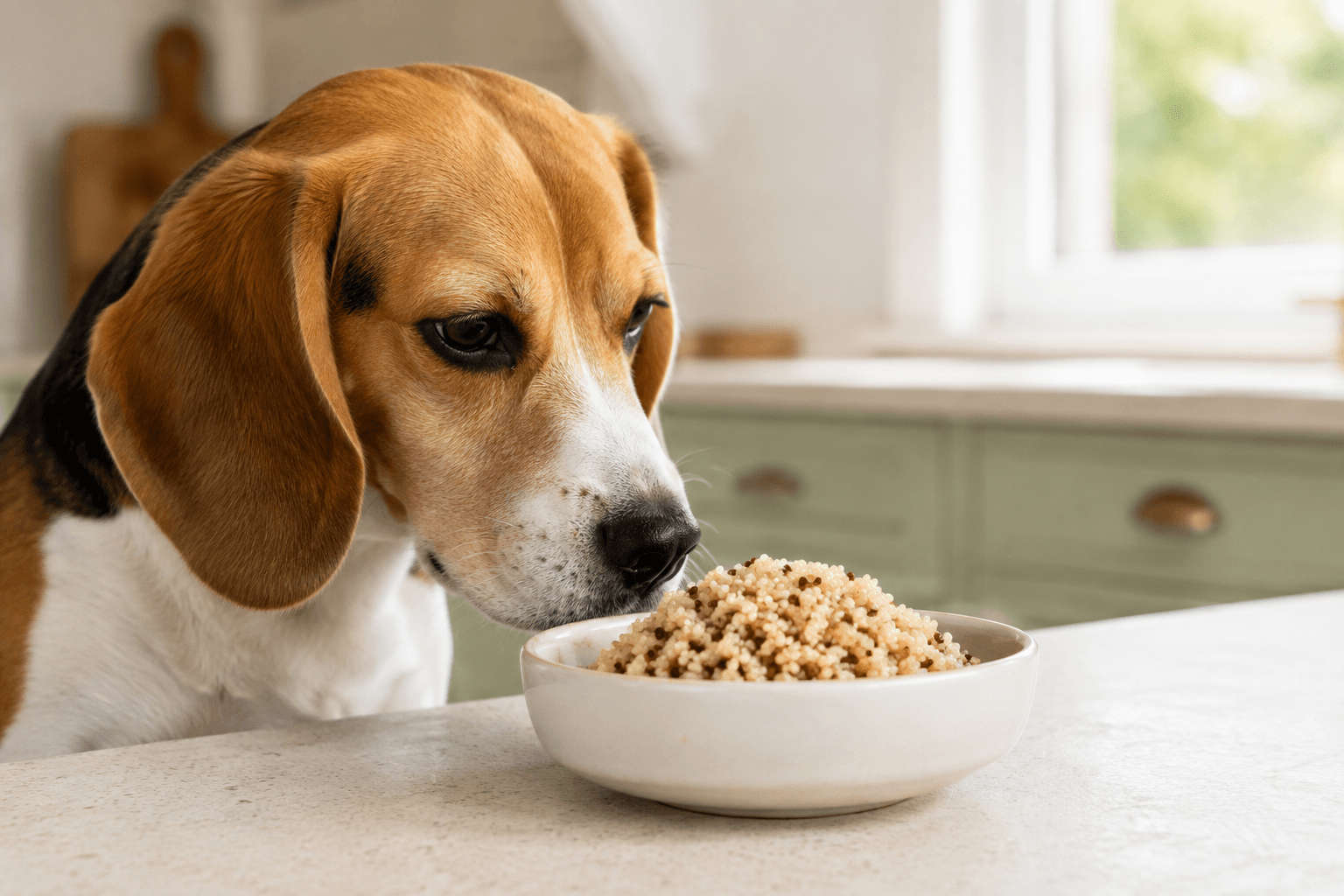
The detail
Quinoa is technically a seed, not a true grain, but it cooks and behaves like one, which is why it turns up as a gluten-free swap for rice or pasta in human and dog diets alike. Plain cooked quinoa carries more protein and fibre than white rice, along with iron and B vitamins.
Every quinoa seed grows with a natural bitter coating called saponin, a compound the plant produces to put off insects and birds. Rinsing dry quinoa under cold running water for a minute or two before cooking washes most of it away, and cooking finishes the job.
Unrinsed or undercooked quinoa is the version that causes trouble. The bitter saponin coating can irritate a dog's gut the way it does a human's if a large amount is eaten unwashed, and the seed's tough outer layer needs a full simmer to soften enough to digest.
Most quinoa sold in UK supermarkets, including own-brand bags from Tesco, Sainsbury's and Waitrose, is labelled pre-rinsed. Giving it a second rinse at home costs nothing and is the more reliable habit, since a 'pre-rinsed' label isn't independently checked.
What is in 100g of plain cooked quinoa
| Protein | Around 4.4g |
| Fibre | Around 2.8g |
| Fat | Around 1.9gSlightly higher than rice, still low overall |
| Gluten | NoneA genuine option for a dog with a wheat sensitivity |
| Anything toxic to dogs | Nothing in the plain, rinsed and cooked seedAn unrinsed saponin coating is the only real caveat |
How much is sensible
| Dog size | Sensible amount |
|---|---|
| Small (under 10kg)Chihuahua, Jack Russell | A teaspoon of plain cooked quinoa, rinsed and fully cooled, a couple of times a week |
| Medium (10 to 25kg)Cocker spaniel, border collie | A tablespoon, mixed into their usual dinner |
| Large (over 25kg)Labrador, German shepherd | Two tablespoons, mixed into their usual dinner |
| Overweight or diabetic dogs | A teaspoon at most; quinoa is more calorie-dense than rice, so it adds up faster |
Rinsing and cooking quinoa properly
Tip dry quinoa into a fine sieve and rinse it under cold running water for a minute or two, rubbing the seeds gently between your fingers, until the water runs clear rather than foamy. That foam is the saponin coating leaving the seed.
Cook it the same way as rice, roughly one part quinoa to two parts water, simmered until the water is absorbed and the seed's tiny white ring is visible. Let it cool fully before adding a spoonful to a dog's bowl, and never season the cooking water with stock, salt or oil.
Can dogs eat raw or dry quinoa?
No. Raw quinoa still carries its full saponin coating and has a tough outer layer that hasn't softened, both of which make it more likely to upset a dog's stomach than a cooked, rinsed portion.
A dog that steals a mouthful of dry quinoa from an open bag is unlikely to need a vet visit, but watch for vomiting, diarrhoea or a gassy stomach over the following day, and keep the bag somewhere they can't reach next time.
Dry quinoa is also small and hard, closer in size to a grain of rice than a chunk of food, so choking isn't a realistic worry the way it might be with a larger raw ingredient. Digestive upset, not a blockage, is the thing to watch for.
Quinoa vs rice for dogs
Rice is the safer default because it's bland and extremely well tolerated, which is why vets recommend it for dogs recovering from an upset stomach. Quinoa carries more protein, fibre and micronutrients, but that richer profile also makes it easier to overdo.
For a healthy dog with no digestive issues, a spoonful of either is a reasonable extra. For a dog on a bland recovery diet or with a sensitive stomach, rice is the better first choice, and quinoa is worth introducing separately once things have settled.
Quinoa flakes, quinoa flour and quinoa in dog food
Quinoa flakes and quinoa flour are just ground or flattened quinoa, so a plain taste carries the same nutrition profile as the whole seed, minus the need to rinse since the saponin has usually been processed out already.
Quinoa also turns up as an ingredient in some complete and grain-free dog foods, usually alongside other pulses and pseudo-grains. That's a formulation decision for a whole diet, not something to worry about if your dog's food happens to list it.
Puffed quinoa, sold as a breakfast cereal ingredient in the UK, is a different product again, since it's often coated in sugar or honey for a human cereal mix. Check the ingredients before sharing a spoonful of your own breakfast rather than assuming plain and puffed are the same thing.
Can dogs eat quinoa salad or cooked quinoa dishes?
Not usually, and it's rarely the quinoa that's the problem. Quinoa salads are typically dressed with oil, vinegar, lemon, feta, dried fruit or onion, and a shop-bought version might include garlic or a heavy salt content from a dressing.
If you want to share quinoa from your own dinner, set aside a plain spoonful before adding any dressing, cheese or onion. A dog gets nothing extra from the finished salad that a plain portion doesn't already provide.
Signs to watch for
- Vomiting, diarrhoea or a gassy stomach after raw or unrinsed quinoa
- Loose stools after too large a portion, since quinoa is more calorie- and fibre-dense than rice
- Stomach upset after a dressed quinoa salad containing onion, garlic or a heavy oil dressing
Common questions
Do I need to rinse quinoa before giving it to my dog?
Yes, even if the packet says pre-rinsed. Rinse it under cold water for a minute or two until the water runs clear, which washes off the bitter saponin coating that can irritate a dog's gut.
Can dogs eat quinoa every day?
A small amount a few times a week is more sensible than daily. Quinoa is more calorie-dense than rice, so a daily habit adds up faster than you'd expect.
Is quinoa better than rice for dogs?
It has more protein, fibre and micronutrients, but rice is gentler and better tolerated by a dog with an upset stomach. Healthy dogs can have either as an occasional extra.
Can puppies eat quinoa?
A small taste of plain, well-rinsed and fully cooked quinoa is unlikely to cause harm, but introduce it slowly and in a small amount, since a puppy's digestive system is more sensitive than an adult dog's.
What happens if my dog eats raw quinoa?
Watch for vomiting, diarrhoea or a gassy stomach over the following day. A small amount from an open bag is unlikely to need a vet visit, but call your vet if symptoms don't settle.
Can dogs eat quinoa salad?
Not the finished dish, since most quinoa salads are dressed with oil, vinegar, onion, garlic or a lot of salt. Set aside a plain spoonful before dressing it if you want to share.