
Can dogs eat pistachios?
Updated 6 August 2026
Not a good idea. Pistachios are not toxic to dogs, but they are roughly 45 percent fat, and Vets Now names pancreatitis as a risk of feeding dogs nuts. The shells are the more common problem, because they are sharp, indigestible and easy for a dog to swallow whole.
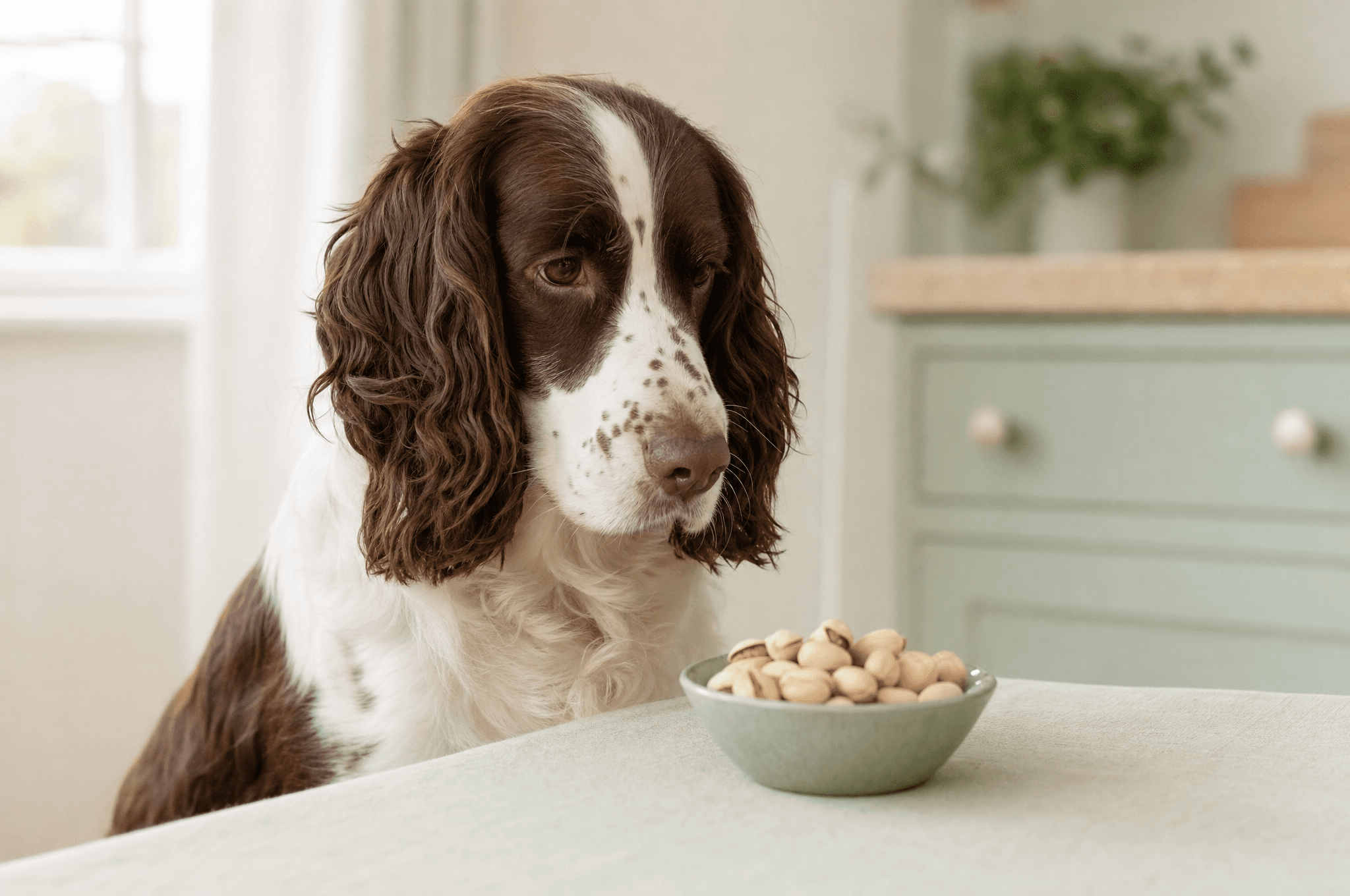
The detail
A dropped pistachio is not an emergency. Vets Now describes pistachios as non-toxic but not optimal, which is close to the whole answer: nothing in the nut will poison a dog, and nothing in it earns a place in the bowl either.
Fat is the reason for the amber rating. A 30g handful carries about 13g of fat and 170 calories, which is roughly a third of what a 10kg dog should eat in a day, and Vets Now says the fat in nuts can cause stomach upset and potentially pancreatitis.
Pistachios also come with more baggage than most nuts. They arrive in shells, they are usually salted or coated, and badly stored nuts grow mould that produces mycotoxins.
What is in a 30g handful of pistachios
| Fat | About 13gPistachios are roughly 45 percent fat |
| Calories | About 170 kcalRoughly a third of a 10kg dog's daily intake |
| Salt (salted varieties) | About 0.3gSalted pistachios run near 1g of salt per 100g |
| Anything toxic to dogs | Nothing in the plain kernelThe shells, the salt, the flavour coatings and mould are the risks |
How much is sensible
| Dog size | Sensible amount |
|---|---|
| Small (under 10kg)Chihuahua, Jack Russell | One or two shelled, unsalted kernels at most, rarely |
| Medium (10 to 25kg)Cocker spaniel, border collie | Two or three shelled, unsalted kernels, rarely |
| Large (over 25kg)Labrador, German shepherd | A few shelled, unsalted kernels, rarely |
| Dogs that have had pancreatitis, or are overweight | None. The fat load is the exact thing to avoid |
The nut itself
Shelled, unsalted pistachio kernels are not poisonous. Vets Now calls them non-toxic but not optimal, and a dog that hoovers up two off the floor needs nothing more than a glass of water and a normal evening.
Quantity changes the answer quickly. Pistachios are about 45 percent fat, and a bowl worked through by a determined labrador is a fat load that Vets Now links to stomach upset and potentially pancreatitis.
Pancreatitis in dogs shows as repeated vomiting, a painful belly, a hunched back and refusing food, usually within a day or two of the fatty meal. It is a vet visit rather than something to sit out at home.
Pistachio shells
The shells are the part to be firm about. Vets Now says particular care should be taken with pistachio shells because they are indigestible, may cause blockages and may be sharp, and a bowl of shells left on a coffee table is exactly the kind of thing a dog empties.
A shell will not dissolve on the way through. It can lodge in the throat, scratch the gut wall or gather with others into a blockage, and small dogs are at the sharp end of all three.
If your dog has eaten shells, ring your vet rather than waiting. Watch for gagging, retching, drooling, a hunched posture, straining or refusing food, and treat any of those as a reason to go in.
Salted and flavoured pistachios
Salted pistachios stack a second problem on the fat. Vets Now points out that nuts tend to come with a lot of salt, which dogs handle less well than people do, and salted pistachios run at roughly 1g of salt per 100g, so a 30g handful carries about 0.3g.
Flavoured varieties are the ones to check hardest. Chilli, barbecue, sour cream and honey-roast coatings routinely list onion powder or garlic powder, and the onion family is toxic to dogs in dried form as well as fresh. Our onion page covers what to do if a flavoured bag goes missing.
If you are sharing at all, share plain unsalted kernels out of the shell. Anything with a coating on it is a no.
Mould and aflatoxin on nuts
Nuts stored warm or damp grow mould, and the mould is worse than the nut. Vets Now says the mycotoxins produced by mould on stored nuts are a serious problem for dogs, and the MSD Veterinary Manual lists nuts among the crops on which Aspergillus moulds produce aflatoxins, in the field or in storage.
Aflatoxins damage the liver, and MSD says dogs should be kept below 50 parts per billion in the diet. Bin anything that smells musty, tastes stale or shows a grey-green bloom, and do not put it on the compost heap a dog can reach.
The same rule covers the bag at the back of the cupboard from last Christmas. If you would not eat it, it does not become a dog treat.
Macadamias are the nut that is actually toxic
Pistachios and macadamias get confused, and only one of them is a poison. VCA Animal Hospitals says macadamia nuts are poisonous to dogs, that it takes only a few nuts to cause illness, and that signs start 3 to 6 hours after eating: vomiting, fever and lethargy first, then wobbliness, reluctance to use the back legs and tremors by 6 to 12 hours.
Most dogs recover fully within 24 to 48 hours with veterinary treatment, but that is not a reason to wait it out at home. Macadamias in cookies and chocolate boxes are the usual route in.
If your dog has eaten macadamias, ring your vet now. If your dog has eaten pistachios, the questions are how many, whether the shells came too, and what was on them.
Signs to watch for
- Vomiting or diarrhoea within a day of a fatty snack
- A hunched posture, a painful belly and refusing food, which can mean pancreatitis
- Gagging, drooling or straining after eating shells
If your dog overdoes it
One or two shelled kernels needs no action. If your dog has eaten shells, a large quantity of nuts, a flavoured bag containing onion or garlic powder, or anything mouldy, ring your vet with your dog's weight and a guess at the amount. For macadamias, ring straight away. Out of hours, Vets Now runs emergency clinics across the UK, and the Animal PoisonLine is on 01202 509000.
Common questions
My dog ate a few pistachios. Should I worry?
Two or three shelled kernels is not an emergency for a healthy dog. Vets Now describes pistachios as non-toxic but not optimal. Put water down and watch for vomiting over the next day.
My dog ate pistachio shells. What now?
Ring your vet. Vets Now says the shells are indigestible, may be sharp and may cause blockages. Watch for gagging, drooling, straining, a hunched posture or refusing food, and go in if any appears.
Are salted pistachios worse for dogs?
Yes. Salted pistachios carry roughly 1g of salt per 100g on top of the fat, and Vets Now notes dogs handle salt less well than people do. Flavoured coatings are worse again, because they often contain onion or garlic powder.
Can pistachios cause pancreatitis in dogs?
Vets Now names pancreatitis as a possible result of the fat in nuts. Pistachios are about 45 percent fat, so a bowlful is a genuine risk. Dogs that have had pancreatitis before should have none.
Are macadamia nuts the same as pistachios for dogs?
No, macadamias are far more dangerous. VCA says they are poisonous to dogs, that a few nuts can cause illness, and that vomiting, fever and wobbliness start within 3 to 6 hours. Ring your vet immediately for macadamias.
What if the pistachios were mouldy?
Ring your vet and take the bag with you. Vets Now says mycotoxins from mould on stored nuts are a serious problem for dogs, and the MSD Veterinary Manual links Aspergillus moulds on nuts to liver-damaging aflatoxins. Bin anything that smells musty.
Can puppies eat pistachios?
No. The fat is a bigger relative load in a small body, and puppies gulp rather than chew, which makes shells and whole nuts more dangerous. Their complete puppy food already covers everything they need.